

Africa’s hopes of producing a second Ballon d’Or winner remain uncertain after only two players from the continent were included in the nominees for the 2026 award.
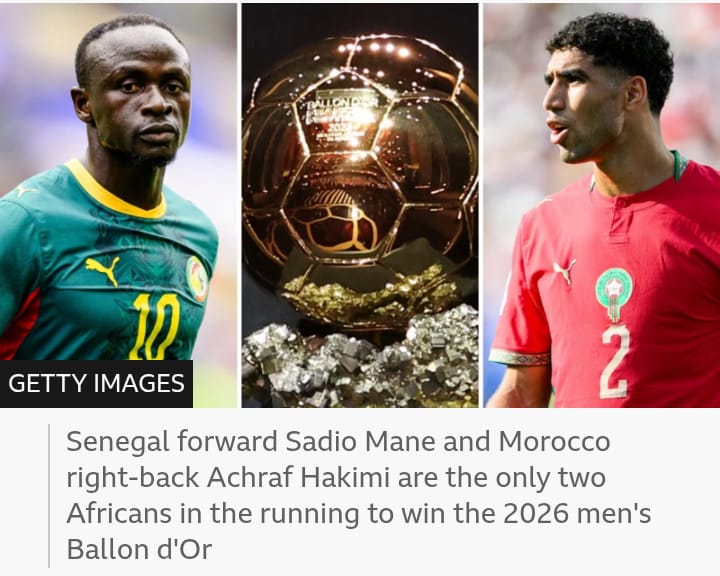
Morocco defender and national team captain Achraf Hakimi, alongside Senegalese attacker Sadio Mané, are among the 30 footballers competing for the prestigious individual honour.
Both have previously finished inside the top six.
However, their prospects this year appear limited following Spain’s World Cup triumph and Kylian Mbappé’s record-breaking campaign, during which the Frenchman became the tournament’s leading scorer with 10 goals.
Africa’s limited presence in the competition is not a new development.
The Ballon d’Or, introduced by France Football in 1956, originally excluded players representing countries outside Europe.
That restriction was removed in 1995.
Liberian icon George Weah immediately made history that year, becoming the first African to win the award after outstanding spells with Paris Saint-Germain and AC Milan.
Since then, however, no African footballer has managed to claim the prize.
Mané came closest in 2022, finishing second behind France international Karim Benzema.
The dominance of Lionel Messi and Cristiano Ronaldo has also made the competition particularly difficult for players from other continents.
The pair collected 13 of the 15 awards presented between 2008 and 2023.
Voting for the 2026 honour will be conducted by journalists representing the 100 highest-ranked nations in FIFA’s standings.
The winner will be unveiled in London on 26 October 2026, at a ceremony marking the award’s 70th anniversary.
The choice of London as the host city is a tribute to Sir Stanley Matthews, the English winger who became the first recipient of the award in 1956.
Weah’s triumph remains the defining moment in Africa’s Ballon d’Or history.
Six African footballers featured among the nominees in that inaugural eligible year, with Weah finishing ahead of Germany’s Jürgen Klinsmann and Finland’s Jari Litmanen.
Africa matched that figure only once more, in 2007.
Ivory Coast striker Didier Drogba was the continent’s leading performer that year, ending the voting in fourth position.
The number of African nominees has generally declined since the field was reduced to 30 players in 2008.
Between 2010 and 2015, the award was merged with FIFA’s world player of the year prize, with only 23 footballers shortlisted during that period.
Another memorable year came in 2019, when three African stars finished among the top 10.
Mané placed fourth, Egypt’s Mohamed Salah was fifth, while Algeria’s Riyad Mahrez occupied 10th position.
Since 1995, African footballers have accumulated 76 nominations, representing just 6.62 per cent of all players shortlisted during the period.
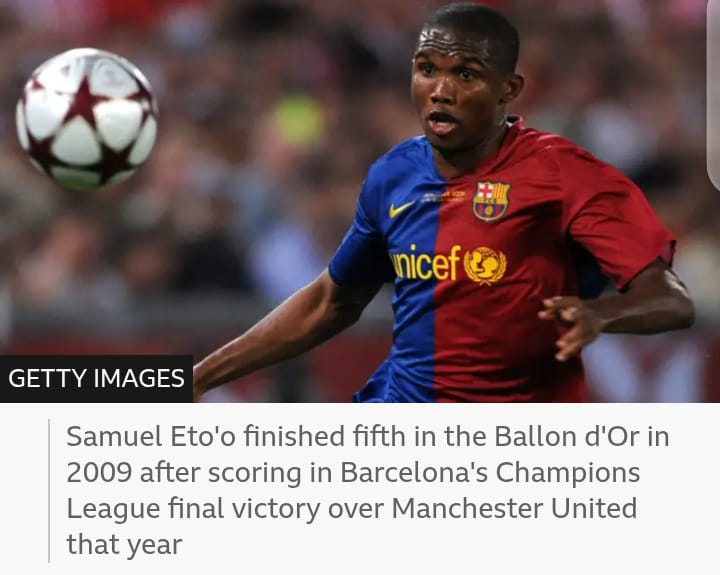
Cameroon great Samuel Eto’o leads the continent for appearances on the shortlist, having been nominated nine consecutive times between 2003 and 2011.
His highest ranking was fifth in 2009.
Drogba has eight nominations, while Salah has six.
Mané, who has now been shortlisted five times, holds the record for the longest gap between his first and latest appearances, spanning a decade.
Nigeria has produced the largest number of different African nominees, with eight players making the list.
Victor Osimhen achieved the country’s best result when he finished eighth in 2023.
Thirty-nine African nations have yet to produce a Ballon d’Or nominee.
Chad is not among them, however, following Japhet N’Doram’s inclusion in 1995 alongside Weah.
The Democratic Republic of Congo and South Africa, ranked 43rd and 54th globally respectively, are the highest-ranked African countries still without a nominee.
No footballer representing a club based on the African continent has ever been shortlisted for the award.
There have also been nine occasions since 1995 when Africa was represented by only one nominee.
The latest came in 2024, when Nigeria’s Ademola Lookman secured 14th place after producing a hat-trick for Atalanta in the Europa League final.
On four occasions, African nominees failed to receive a single vote.
Those instances involved Nigeria’s Sunday Oliseh in 1998, Cameroon’s Geremi and Patrick Mboma in 2000, Ghana’s Samuel Kuffour in 2001, and Eto’o and Tunisia’s Hatem Trabelsi in 2003.
By: Magdalene Agyeiwaa Sarpong