

Image@ BBC
At least eight people have lost their lives after extraordinary rainfall triggered flooding, landslides and widespread disruption across eastern Japan, leaving thousands of travellers stranded at Narita International Airport.
Chiba Prefecture, located east of Tokyo, experienced exceptionally intense downpours from Thursday afternoon.
Officials said rainfall exceeded 100 millimetres within an hour in some areas, marking the highest hourly precipitation ever documented in the country.
The Japan Meteorological Agency described the weather as an “unprecedented level of heavy rain”.
Warm, moisture-laden air moving towards eastern Japan collided with colder air at higher altitudes, creating highly unstable atmospheric conditions.
Chiba Governor Toshihito Kumagai said the scale of the disaster was unlike anything he had previously encountered.
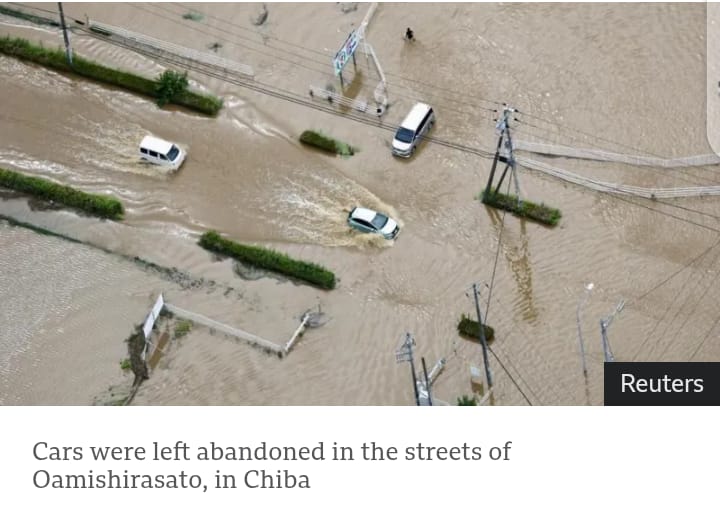
More than 20,000 homes lost electricity, while over 100,000 households were urged to leave their residences as flooding and mudslides intensified.
Emergency authorities raised the warning to its maximum level on Thursday before reducing it to level four on Friday.
Among the fatalities was a woman who became trapped inside her vehicle after it was engulfed by floodwater.
Two other people reportedly collapsed outdoors and subsequently died.
Transport networks were also badly affected.
Several railway routes remained out of service on Friday, while sections of major roads were closed because of dangerous conditions.
Commuters were stranded at stations, and approximately 1,800 people spent the night inside the Chiba Prefectural Government headquarters.
Narita Airport said flights were expected to continue operating on Friday, although Japan Airlines warned that some services could experience delays.
No widespread cancellations were anticipated.
Residents described the rainfall as sudden and overwhelming.
One woman from Ichikawa told Japanese broadcaster NHK that the storm arrived without warning and left her concerned about whether she would be able to reopen her business because of the power failure.
The severe weather has also affected the Philippines, where authorities once again suspended classes and government operations across much of the northern region because of flood threats.
The latest emergency follows a succession of powerful storms that have affected Japan, China and the Philippines in recent days.
Typhoons Dolphin, Chan-Hom and Peilou moved through parts of East Asia almost simultaneously.
Dolphin caused significant damage in Japan’s Okinawa region, knocking out electricity to tens of thousands of buildings, bringing down trees and forcing flight cancellations.
In China, more than one million residents were moved to safer locations over the weekend as Dolphin, described by authorities as the strongest typhoon to strike the country this year, reached the eastern coast.
Meteorologists expect the torrential conditions in eastern Japan to continue until late Friday, with officials maintaining warnings over the possibility of further flooding and landslides.
By: Magdalene Agyeiwaa Sarpong