

Mackenzie was found guilty in October of the murder of 190 children and one adult
A Kenyan court has handed Paul Mackenzie, the leader of a religious cult, a 200-year prison sentence for orchestrating the deaths of 191 people, including 190 children, through extreme starvation practices.
Mackenzie was convicted alongside 28 associates who participated in enforcing his instructions that followers should abstain from food until they died, believing this would enable them to enter heaven and meet Jesus.
Delivering the sentence, Justice Diana Mochache identified Mackenzie as the principal mastermind behind the killings, describing his actions as deliberate and deserving of the harshest punishment permitted under Kenyan law.
The court imposed 100 years for homicide and an additional century for offences connected to starvation.
Although sentences under each category will run simultaneously, the two separate terms will be served successively, resulting in a total of 200 years behind bars.
His accomplices, including security personnel and individuals responsible for burying victims, received various prison terms, with the longest reaching 160 years.
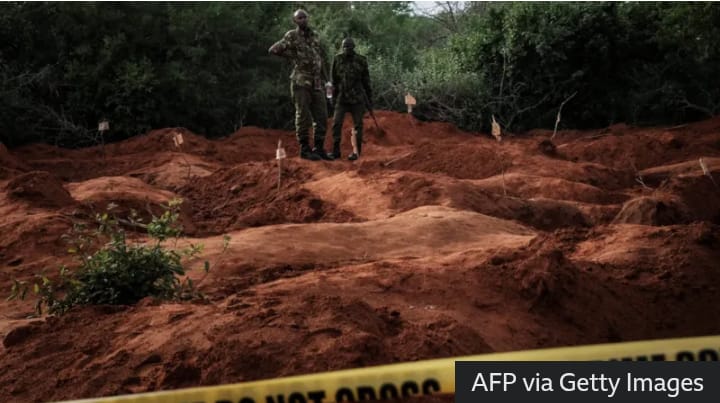 More than 400 bodies were dug up in Shakahola forest
Prosecutors had requested capital punishment, citing the extraordinary scale of the tragedy. However, the presiding judge rejected the appeal, arguing that execution would remove opportunities for rehabilitation. Kenya last carried out a death sentence in 1987.
The 2023 investigation began after authorities uncovered numerous graves in Shakahola forest, situated near the coastal town of Malindi.
More than 400 bodies have since been recovered, making the incident one of the most devastating religious extremism cases recorded globally.
Medical examinations established starvation as the leading cause of death, although several victims suffered fatal injuries from strangulation, suffocation and physical assault.
Court proceedings further established that Mackenzie’s followers regarded him as a divine messenger. Individuals who challenged his instructions reportedly faced violent punishment, while deceased members were allegedly celebrated as people who had spiritually married Jesus.
The judgement also exposed serious failures within Kenya’s security and administrative institutions. Investigations by the Kenya National Commission on Human Rights indicated that authorities had received warnings about the group’s operations but failed to intervene promptly.
Francis Wanje, who lost eight family members, including two grandchildren, expressed hope that the punishment would reflect the suffering experienced by affected households.
He disclosed that he had alerted police in March 2023 but was disappointed by the delayed response.
Mackenzie founded Good News International Ministries in 2003, attracting thousands of followers through religious branches and televised preaching. His messages portrayed formal education, medical treatment and digital identification systems as incompatible with his religious beliefs.
After shutting down his main church in 2019, he relocated to Shakahola forest and encouraged members to join him. He was subsequently arrested in 2023 following revelations about the deaths.
Although the latest convictions represent a significant development for survivors and bereaved families, hundreds of recovered bodies remain outside the 191 deaths covered by the murder proceedings.
Mackenzie is also facing separate manslaughter and terrorism cases, charges he has denied.
By: Magdalene Agyeiwaa Sarpong