

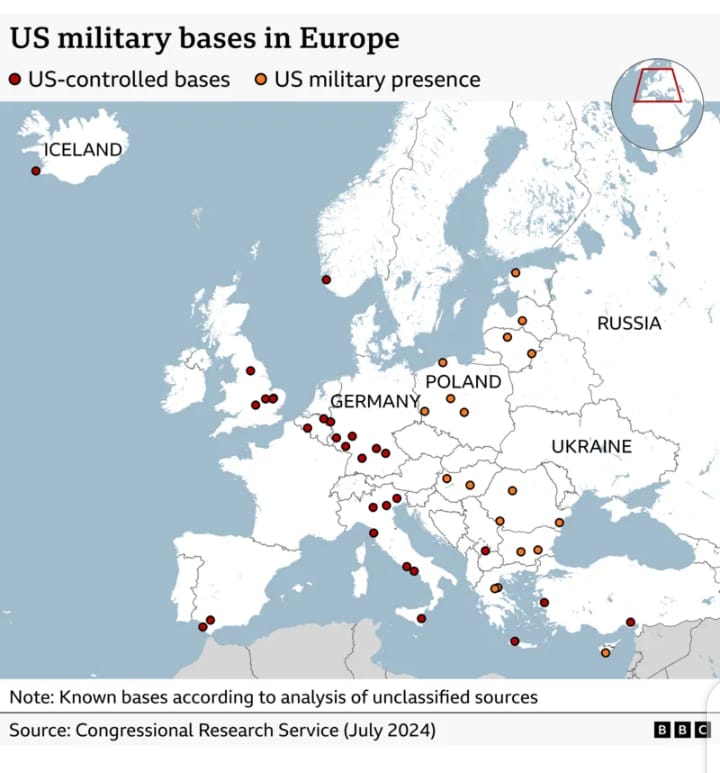
US To Deploy Additional 5,000 Troops To Poland Amidst Shifting Military Strategy/Image@ BBC
U.S. President Donald Trump has announced the deployment of an extra 5,000 American troops to Poland, just one week after the Pentagon scrapped plans for sending 4,000 troops to the nation.
In a post on his Truth Social platform on Thursday, President Trump attributed the decision to the strong relationship he shares with Polish President, Karol Nawrocki, whom he supported during last year’s presidential elections and who has been a steadfast ally.
Details regarding whether these additional troops are part of the previously planned deployment or represent a new initiative were not clarified by the president.
NATO Secretary General, welcomed the announcement ahead of an upcoming meeting of foreign ministers in Sweden.
Dutch Prime Minister, Mark Rutte, remarked that Europe’s journey towards reduced reliance on the United States “will continue.”
Polish Prime Minister, Donald Tusk, described the news as “positive” for both nations, expressing gratitude on social media to all parties involved, including President Nawrocki, ministers, congressmen, and American supporters of Poland for their effective collaboration.
Last week, the defense department abruptly canceled the earlier troop deployment to Poland.
However, U.S. Defense Secretary, Pete Hegseth, later characterized this as “a temporary delay,” assuring that Washington remains committed to maintaining a robust military presence in the region.
The White House has indicated in recent weeks a desire to lower its overall troop levels in Europe as part of its “America First” strategy.
Senator Marco Rubio is anticipated to advocate for increased burden-sharing among NATO allies during discussions in Helsingborg on Friday.
Speaking to reporters prior to the summit, Rubio expressed disappointment with some NATO partners regarding their responses to U.S. operations in the Middle East while highlighting ongoing cooperation, including the announcement concerning Poland.
He emphasized that the United States has global commitments that necessitate constant reassessment of troop deployments, clarifying that this process is not punitive.
Earlier, when questioned about unverified reports suggesting a potential reduction in total U.S. troop numbers available in case of an attack on a NATO member, Rubio indicated that “some of those issues” would be addressed at the summit, reiterating President Trump’s frustration with NATO allies.
German Foreign Minister, Johann Wadephul, also praised the decision to bolster troop presence in Poland, stating it enhances not only Poland’s security but also that of the entire alliance, which aligns with Germany’s interests.
Earlier this month, the U.S. announced plans to withdraw 5,000 troops from Germany following tensions between President Trump and German Chancellor, Friedrich Merz, over the conflict with Iran.
It remains unclear whether the additional troops designated for Poland are part of those withdrawing from Germany or constitute a separate contingent.
Wadephul mentioned on Friday that Germany is engaged in “continuous discussions” with the U.S. regarding the potential deployment of long-range missile systems within its borders. “We are encouraging the United States to adhere to their earlier commitments,” he stated.
Several Republican representatives in the U.S. have voiced concerns over Trump’s choice to withdraw troops from Germany, arguing that it could convey an inappropriate message to Russia.
The U.S. military presence in Germany remains the largest in Europe, with over 36,000 troops actively stationed there, compared to approximately 12,000 in Italy and 10,000 in the UK.
President Trump has previously criticized Merz for suggesting that the U.S. had been “humiliated” during negotiations with Iran aimed at resolving the conflict in the Middle East.
The president has also expressed dissatisfaction with NATO allies for their reluctance to join him in applying pressure on Iran concerning the Strait of Hormuz.
Rubio remarked on Friday that there has been “some progress” in discussions related to Iran, although he did not provide further specifics.
”We are awaiting updates on those ongoing conversations…I don’t want to overstate it, but there has been a bit of movement,” he noted.
By: Magdalene Agyeiwaa Sarpong