

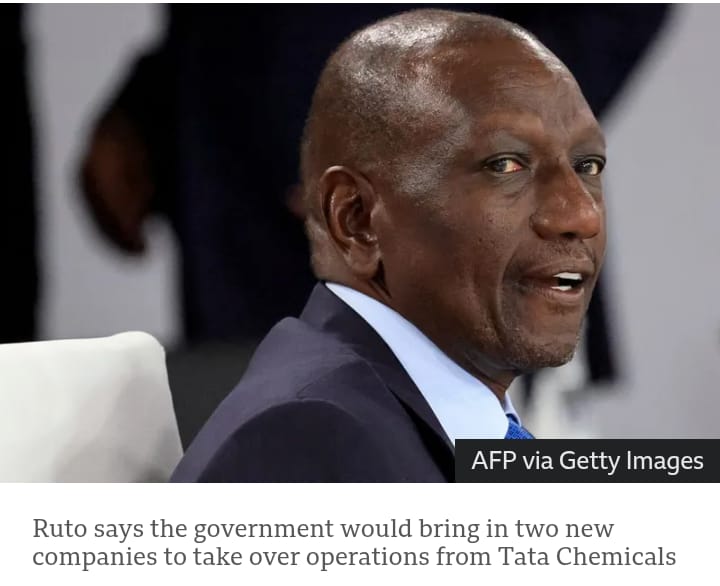
Kenyan President William Ruto has directed Indian-owned Tata Chemicals to withdraw from the country, accusing the company of failing to deliver sufficient economic value from the natural resources it extracts.
Ruto said the firm had focused on shipping soda ash overseas rather than expanding local manufacturing to produce products such as glass and industrial chemicals.
Speaking during a visit to Kajiado County, where the company’s Magadi facility is located, the president said the government had already identified prospective investors to assume control of the operation.
He argued that new ownership would create more jobs, attract capital and increase the amount of mineral processing carried out within Kenya.
Tata Chemicals, a subsidiary of India’s Tata Group, said it accepted the government’s position but would continue discussions through the relevant legal and regulatory processes.
The company operates near Lake Magadi, approximately 120km southwest of Nairobi, and sends more than 350,000 tonnes of soda ash to international markets each year, including destinations in Asia, the Middle East and other African countries.
Kenya ranks among the leading global producers of naturally sourced soda ash, contributing about 1% of worldwide output, according to figures from the US Geological Survey.
Soda ash, chemically known as sodium carbonate, is obtained from natural mineral deposits and brines.
It is widely used in the manufacture of glass, detergents, chemicals, paper, textiles, batteries and water-treatment products.
Tata Chemicals is among Kenya’s major mineral exporters and is regarded as Africa’s largest soda ash producer.
It mines trona from Lake Magadi before refining the mineral into soda ash.
Company accounts for 2024 showed sales of approximately 245,000 tonnes of soda ash and revenue of about $78.7m.
The Magadi operation employs around 500 workers, while Tata Chemicals says its social investment programmes support nearly 30,000 residents in surrounding communities through initiatives involving water supply, healthcare, schools, roads and other infrastructure.
However, Ruto criticised the company’s contribution to the region, arguing that Kenya had not gained enough from the long-standing mining arrangement.
The president said Tata Chemicals Magadi had operated under a contract spanning about a century but had failed to establish significant manufacturing facilities in Kajiado.
His latest remarks follow an order issued five weeks earlier by Kenya’s mining minister instructing the company to halt production.
The directive reportedly followed concerns over unpaid royalties and alleged non-compliance with other regulatory obligations.
Tata Chemicals said it had submitted detailed explanations addressing the issues raised by the ministry, including evidence concerning its adherence to applicable regulations.
The company is now waiting for authorities to assess its response and communicate the next steps.
Mining activities at Lake Magadi have a history stretching back more than a century.
The operation began in 1911, while a major mining agreement with the Kenyan government was concluded in 1928.
Tata Chemicals assumed ownership of the Magadi business in 2005 after purchasing it from the British company Brunner Mond Group.
By: Magdalene Agyeiwaa Sarpong