

Image@ Reuters
Saudi Arabia, Türkiye and Pakistan have entered into a new security arrangement designed to deepen military cooperation and strengthen their ability to respond collectively to external threats.
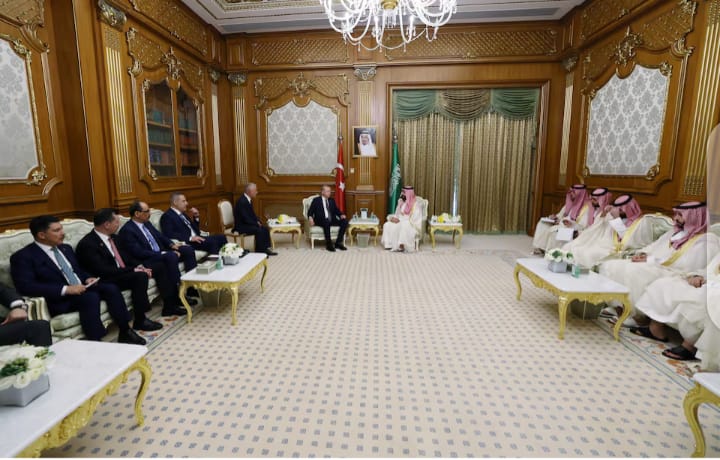
The agreement, signed in Mecca on Friday by Saudi Crown Prince Mohammed bin Salman, Turkish President Recep Tayyip Erdoğan and Pakistani Prime Minister Shehbaz Sharif, comes as escalating hostilities across the Middle East continue to threaten Gulf countries and vital energy routes.
Known as the Mecca Joint Defence Agreement, the accord declares that an assault on any one of the three countries would be treated as an attack against all members.
However, the governments did not disclose detailed provisions outlining the military assistance that would be required if such a situation arose.
Turkish Vice President Cevdet Yilmaz stressed that the arrangement was not directed against a particular nation.
A Turkish official also described it as a defensive initiative that would not interfere with Ankara’s existing security commitments.
The deal brings together three strategically important Muslim-majority countries.
Türkiye possesses NATO’s second-largest armed forces, Saudi Arabia is a leading global petroleum supplier and custodian of Islam’s two holiest cities, while Pakistan remains the only Muslim-majority state with nuclear weapons.
Saudi deputy minister for public diplomacy Rayed Krimly rejected suggestions that the agreement was intended to create a new military alliance based on religion.
He said it was neither a sectarian grouping nor connected to nuclear proliferation or an arms competition.
 Image@ Rueter
The announcement follows months of negotiations and comes against the backdrop of intensified confrontation involving Israel, Iran and armed groups operating across the region.
Since the outbreak of the latest phase of Middle Eastern hostilities, several Gulf states have faced missile attacks and disruptions affecting commercial and energy transportation.
The instability has raised concerns over oil supplies and exposed vulnerabilities in Saudi Arabia’s ambitious economic development programme.
Analysts say Riyadh’s growing interest in regional security cooperation also reflects uncertainty surrounding the strength and dependability of its longstanding relationship with Washington.
Abdulaziz Sager, head of the Saudi-based Gulf Research Center, said the three governments were demonstrating a greater readiness among influential regional powers to take responsibility for their own security.
He argued that closer coordination could enhance their diplomatic influence and military capabilities while helping establish a security framework driven increasingly by countries within the region.
Researcher Burcu Ozcelik of the Royal United Services Institute said the initiative appeared aimed at creating a stronger deterrent against both Iran and Israel rather than preparing for a direct confrontation with Tehran.
Pakistan has maintained extensive military ties with Saudi Arabia for decades, providing personnel training and technical support.
Islamabad has previously deployed thousands of troops and military equipment to the kingdom, including aircraft, unmanned systems and air-defence capabilities.
Despite its longstanding relationship with Riyadh, Pakistan has refrained from directly entering the conflict with Iran.
Pakistani authorities have also repeatedly dismissed speculation that their nuclear capability could be made available to Saudi Arabia.
Türkiye and Pakistan have similarly expanded defence cooperation through military training, naval exchanges and aircraft-related programmes.
Riyadh is also a significant buyer of Turkish-made drones.
Both Ankara and Islamabad have backed Saudi plans for a maritime security arrangement intended to safeguard shipping and crucial energy corridors.
The new agreement follows a separate Saudi-Pakistani defence understanding reached last year, although Islamabad has so far avoided deploying its forces against Iran.
Meanwhile, Pakistan has begun discussions with Kuwait on a possible security partnership that could involve military support alongside economic and energy cooperation.
Israel’s Prime Minister Benjamin Netanyahu’s office declined to comment on the latest agreement, while India’s Foreign Ministry said it was monitoring developments.
Iranian authorities had not immediately issued a response.
The pact comes at a time when Saudi Arabia is seeking greater protection for its territory, oil infrastructure and economic ambitions amid an increasingly unstable regional security environment.
By: Magdalene Agyeiwaa Sarpong