

A 23-year-old man, Vickrum Digwa, has been sentenced to life imprisonment with a minimum term of 21 years for the fatal stabbing of 18-year-old Henry Nowak in Southampton.
The incident occurred on December 3, 2025, as Nowak was returning home alone after a night out with friends.
Digwa claimed he carried a 21cm (8in) knife as part of his Sikh faith, but he used it to fatally wound Nowak.
Following the attack, police handcuffed Nowak while he lay dying, as Digwa falsely asserted that he had been racially insulted and acted in self-defense. He alleged that his turban had been knocked off and that he had sustained injuries.
During the sentencing at Southampton Crown Court, Judge William Mousley KC condemned Digwa’s actions, stating that he had brought “shame” upon both his family and his faith.
Bodycam footage released by Hampshire and Isle of Wight Constabulary, with permission from the victim’s family, depicts the chaotic scene as officers arrived.
In the video, Nowak can be heard repeatedly stating, “I’ve been stabbed” and “I can’t breathe.”
Despite his condition, officers turned him onto his side and handcuffed him behind his back.
After a few moments, he became unresponsive, and an officer informed him he was under arrest for assault before calling for medical assistance.
Temporary Deputy Chief Constable, Robert France, expressed regret over the situation, acknowledging that officers had been misled by a 999 call from Digwa’s brother and faced a “highly complex” crime scene.
Judge Mousley dismissed Digwa’s claims of racism, noting that his actions had incited racial tensions in Southampton and beyond, causing concern among many Sikhs about their safety.
He remarked on the irony of Digwa being sober while carrying a large ceremonial dagger.
The judge emphasized the impact of the murder on Nowak’s family, describing him as a “much-loved” young man whose death has left a “lifetime of loss.”
Outside the courthouse, Mark Nowak, the victim’s father, expressed anguish over the treatment of his son compared to Digwa.
He stated that “Henry should not have died on the streets of Southampton in police custody,” describing the situation as “inhumane and degrading.”
He criticized the disparity in how they were treated, noting that Digwa was never handcuffed.
Mark Nowak called for a thorough investigation into the police’s handling of the case, insisting that the family should not have to fight for justice.
The Hampshire and Isle of Wight Constabulary has referred itself to the Independent Office for Police Conduct (IOPC).
In court, Mark Nowak shared his torment over his son’s tragic death, lamenting, “I couldn’t help Henry in his final moments, and there is nothing I can do to bring him back.”
With emotion in his voice, he added, “To my dying son, who I love beyond words, I’m so sorry that I let this happen.”
Prosecutor Nicholas Lobbenberg KC, described Digwa as having a “weapons obsession” and criticized his portrayal of Nowak as a “racist, drunk, violent aggressor,” which only added to the grief experienced by the deceased’s family.
Sir Keir Starmer commented on the case via social media platform X, calling it “an awful, shocking case.”
He acknowledged the trauma endured by Henry’s loved ones throughout the lengthy trial and emphasized the need to address the ongoing issue of knife crime to prevent further tragedies.
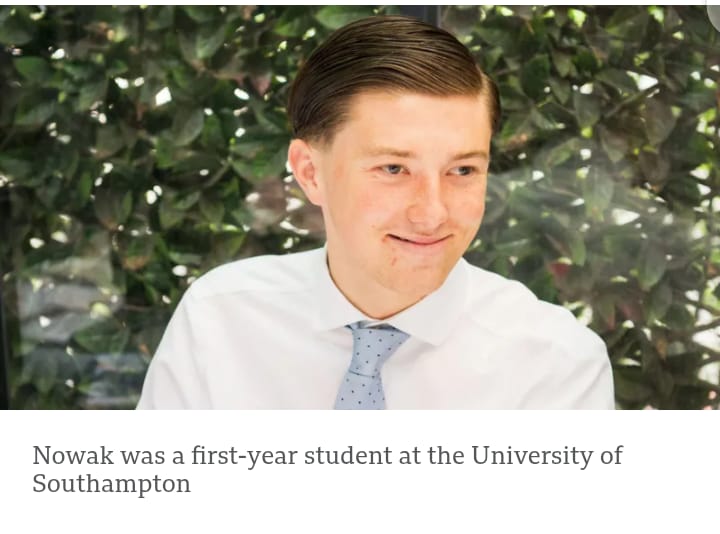
Henry Nowak, a first-year student at the University of Southampton from Chafford Hundred in Essex, was walking back to his residence after consuming alcohol at levels below the legal driving limit.
At approximately 23:30 GMT, Vickrum Digwa was in Belmont Road, armed with the murder weapon secured in a sheath on his belt.
While no one witnessed the assault, neighbors reported hearing Nowak declare that he had been stabbed and was in critical condition.
In a desperate attempt to flee, he climbed over a fence, leaving a trail of blood behind him.
The prosecution revealed that he suffered five stab wounds, two to the back of his legs, one to the face, and a fatal injury to his chest.
After the attack, Digwa handed the knife to his mother, who later had it discovered by police at their family residence, along with over 20 additional weapons.
Hampshire Police and Crime Commissioner, Donna Jones, labeled the incident a “national tragedy.”
She expressed her dismay that officers did not trust Henry Nowak when he claimed he had been stabbed and was struggling to breathe.
”The circumstances surrounding the police response raise serious questions about their impartiality, fairness, and judgment,” she stated.
She assured that any conclusions drawn by the Independent Office for Police Conduct (IOPC) would be acted upon immediately.
The Sikh Federation clarified that the knife used by Digwa was not a religious blade known as a kirpan.
They criticized the Crown Prosecution Service (CPS) for failing to clarify this during the trial, stating that the community has been unfairly portrayed.
According to Section 139 of the Criminal Justice Act 1988, an individual charged with possessing a bladed item in public can argue that they carried it for religious purposes. However, if the item is used in violence, it is considered an offensive weapon.
The CPS maintained that Digwa intentionally carried two ceremonial knives and that the judge’s findings supported their assessment that this was a kirpan that Digwa opted to wield.
Following Digwa’s conviction, notable right-wing figures, including Elon Musk, have criticized existing UK laws regarding knife possession.
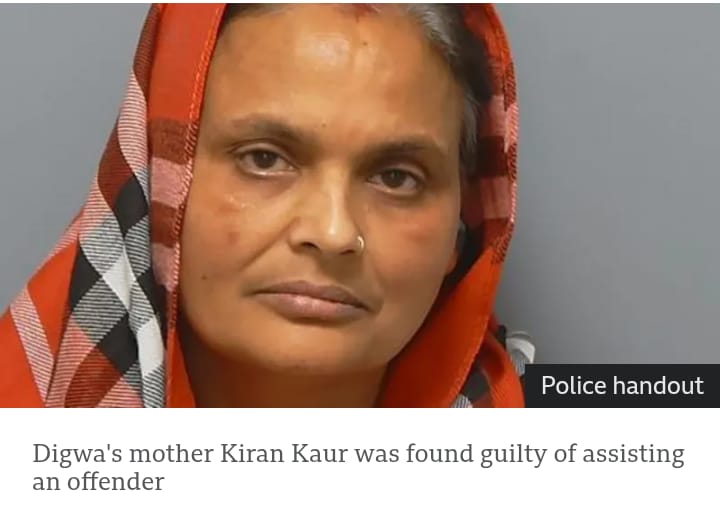
Digwa also received a sentence for carrying a knife in public, while his mother, Kiran Kaur, 53, was found guilty of aiding an offender for her efforts to conceal the weapon used in the crime.
She is set to be sentenced on July 17.
By: Magdalene Agyeiwaa Sarpong