

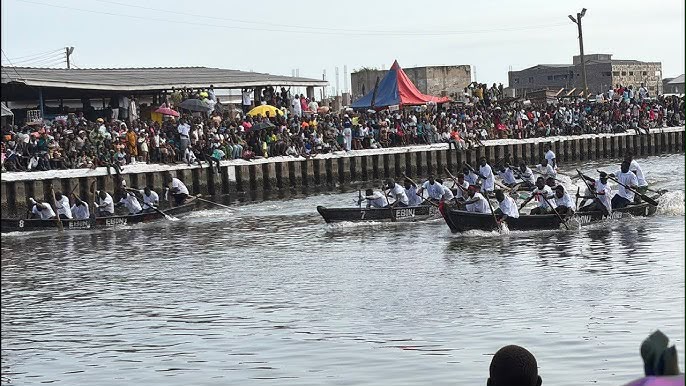
Bakatue, a Fante word meaning “the opening of the lagoon,” dates back to 1847, when chiefs and elders in Elmina established the festival to protect fishing traditions and strengthen the community’s spiritual bond with the lagoon. Celebrated every year on the first Tuesday of July, it has grown into one of Ghana’s most significant cultural festivals, attracting traditional leaders, opinion leaders, tourists and members of the diaspora. The festivities feature colourful durbars, libation ceremonies, drumming and the symbolic casting of fishing nets into the lagoon.
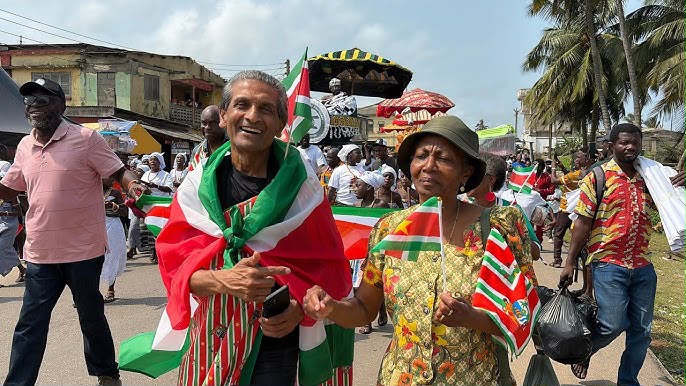
This year’s celebration attracted an even stronger international presence. Alongside Czech Ambassador Pavel Bílek, the Netherlands’ Jeroen Verheul and Suriname’s Fidelia Graand-Galon also attended, according to local broadcaster TW Radio. Their participation highlighted Elmina’s growing importance as a destination for foreign diplomats in Ghana. As the site of Ghana’s first contact with European traders in the 15th century, Elmina has long given the festival a diplomatic dimension. The attendance of several ambassadors, together with an expected appearance by President John Dramani Mahama at the grand durbar, gave this year’s event added prominence.
For the Czech Republic, the visit reflected a relationship that has steadily expanded over the years. The Czech Embassy said its ties with Elmina have been built through development cooperation, business partnerships and people-to-people exchanges, not only through official state engagements. Those links were visible throughout the festival, with Czech national flags displayed across parts of the town.
A central figure in that relationship is David Duron, a Czech-born chief known in Elmina by his stool name, Nana Ekow Ankama I. The embassy credited him with helping strengthen relations between the two countries and thanked residents for the warm welcome extended to Ambassador Bílek. Duron’s role as a naturalised traditional leader highlights a lesser-known side of Ghana’s story, where foreigners have embraced chieftaincy and community leadership, forging connections that reach beyond trade and development assistance.
The Netherlands and Surinamese presence, in particular, reflects history rather than novelty. Elmina was the seat of the Dutch Gold Coast for more than two centuries, after the Dutch West India Company captured its castle from the Portuguese in 1637 and made it their headquarters for trade along the coast. Dutch involvement deepened further in 1664 when the Dutch conquered Suriname, and thousands of enslaved people taken from the Gold Coast, many of them Akan-speaking, were forced onto Surinamese plantations, laying the foundation for what is today a large Afro-Surinamese population that traces its ancestry back to towns like Elmina.
That shared bloodline has outlasted colonial rule. Ghanaian-Dutch diplomatic relations are formally dated to 1701, when a working relationship was struck between the Dutch and the Ashanti, and the two countries marked its 300th anniversary in 2001 with a programme of heritage events. Elmina itself still carries the imprint of that era: many residents bear Dutch surnames inherited from centuries of intermarriage between European traders and local families, and the town continues to mark a “Dutch Christmas” every January as part of its intangible cultural heritage.
Suriname’s presence in Accra carries similar weight. The Dutch government’s 2025-2028 international cultural policy names Ghana a newly added focal country specifically because it is, as officials describe it, the original homeland of a significant share of the Surinamese population and, by extension, the Afro-Surinamese diaspora now living in the Netherlands. That policy points to emerging opportunities for cultural exchange built on shared heritage between the three nations, a dynamic that made Ambassador Graand-Galon’s appearance at Bakatue read as more than protocol.
Organisers say Bakatue is much more than a cultural display. For the Edina Traditional Area, it represents spiritual renewal, community unity and the passing of fishing knowledge and sustainable practices to younger generations. At the same time, the festival continues to showcase Elmina as a destination for visitors from Ghana and abroad. This year’s celebration, marked by diplomatic participation and the display of Czech flags, demonstrated how a centuries-old tradition continues to attract international interest while preserving its cultural identity.
By: Andrews Kwesi Yeboah