

Kenyans are confronting a growing shortage of fresh milk, raising concerns among households, restaurants and tea vendors in a country where milky tea, commonly known as chai, is a daily staple.
Milk is traditionally central to Kenyan breakfasts and social gatherings, with many people drinking several cups of tea throughout the day.
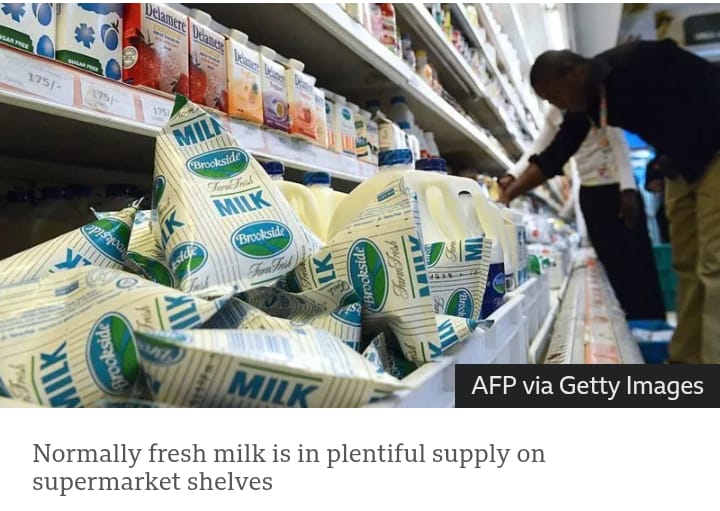
However, supermarket refrigerators in Nairobi and other urban centres are increasingly running low, while some retailers have raised prices and introduced purchasing limits.
Authorities have linked the situation partly to prolonged dry conditions, which have reduced grazing areas and affected dairy production.
However, the Kenya Dairy Board (KDB) has acknowledged that the sector is experiencing supply difficulties and depleted stocks.
Muthoni Macharia, a Nairobi restaurant operator who normally purchases more than 70 packets of fresh milk, said the scarcity had disrupted her business.
“Where has the milk gone?” she asked while searching several outlets for supplies to meet demand from customers.
Macharia said the problem had persisted for about a week and was particularly severe during the morning rush.
Some customers have switched to black tea, although others insist on having milk in their drinks.
Kenya is among Africa’s major dairy-producing countries, with processed milk especially popular in towns and cities.
Rural communities tend to consume greater quantities of raw and fermented milk.
The shortage has generated public anxiety and prompted speculation, including unsupported claims that supermarkets are intentionally restricting supplies to increase profits.
Figures from the KDB show that deliveries of milk to processing companies dropped from 84.4 million litres in June to 81.3 million litres in July, representing a 3.7% decline.
Preliminary figures indicate that supplies fell further in August.
The Consumer Federation of Kenya (Cofek) says the decline has been evident since the start of the year.
It blames delayed rains and shrinking pasture, alongside a 45% increase in livestock feed costs.
Cofek has also criticised higher prices and supply restrictions. It says the cost of fresh milk has increased from about 70 to 80 Kenyan shillings per litre.
The consumer organisation argues that the current crisis could have been reduced if more milk had been converted into powder during last year’s period of excess production.
Dairy companies commonly turn powdered milk back into liquid during dry periods when fresh supplies decline. Cofek says inadequate stockpiling meant the industry lacked an important reserve when production weakened.
It has called for government assistance through livestock-feed support, tax relief on feed imports and stronger supervision of retail prices to prevent excessive increases and unnecessary restrictions.
KDB Managing Director William Maritim described the situation as a temporary supply problem and maintained that milk remained available.
He said fresh pasteurised varieties, which spoil more quickly, had been affected more severely than long-life UHT products.
Consumers in Nairobi have nevertheless expressed frustration over the changing prices and difficulty finding milk.
Bernard Abok, who shops after work, said he sometimes found empty shelves and noticed that prices increased whenever supplies became available.
Patricia Gathoni said continued price increases could force her family to reconsider its consumption. She said she had even begun diluting the milk she was able to purchase with water.
Agriculture ministry officials met dairy processors on Thursday to discuss measures aimed at restoring supplies, assisting farmers and protecting consumers.
Jonathan Mueke, the ministry official responsible for livestock development, said the immediate priority was increasing access to animal feed.
One measure under consideration is duty-free importation of yellow maize for livestock feed.
The government is also examining longer-term measures to balance production during periods of excess supply and scarcity.
Milk wastage has frequently occurred in Kenya during periods of overproduction, when farmers struggle to find buyers or adequate storage facilities for their perishable produce.
Mueke said authorities were considering establishing a fund to help preserve milk during periods of surplus, creating reserves that could later be released when production falls.
The government is also exploring the possibility of temporarily importing milk from neighbouring countries to bridge the current gap.
For millions of Kenyans accustomed to starting their day with a steaming cup of milky chai, such measures could provide much-needed relief.
By: Magdalene Agyeiwaa Sarpong