

Astronauts aboard the International Space Station (ISS) were instructed to take refuge in a docked spacecraft following an unexpected air leak.
On Friday afternoon, five of the seven crew members were ordered to enter the SpaceX shuttle Dragon “Freedom,” preparing for a possible evacuation.
Meanwhile, two Russian cosmonauts remained on the ISS, attempting to address issues in the Russian segment where the air leaks had intensified since Monday.
Their repair efforts were halted, and NASA subsequently directed the crew to return to the station.
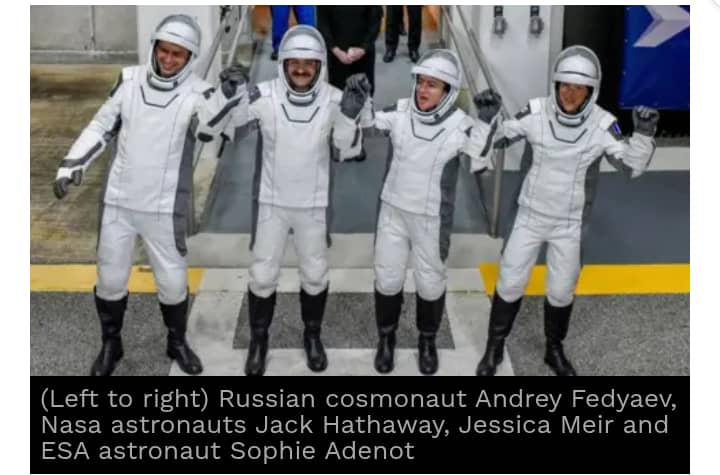
Jessica Meir, Jack Hathaway, Sophie Adenot, Andrey Fedyaev, and Chris Williams, who arrived at the ISS in February, donned their spacesuits while sheltering in the Dragon, ready for a quick departure back to Earth if necessary.
The Dragon serves as a lifeboat, remaining attached to the ISS but capable of detaching at a moment’s notice.
The air leak originated in the transfer tunnel known as PrK, leading to the Zvezda service module within the Russian segment.
Cosmonauts Sergey Kud-Sverchkov and Sergei Mikaev were working on repairs when NASA raised safety concerns about their methods.
The decision to seek shelter was prompted by a new pressure drop detected in the tunnel after a Russian cargo ship’s arrival last month, leading Roscosmos to initiate more comprehensive repair efforts rather than temporary fixes.
Reports indicated that Kud-Sverchkov and Mikayev were using a saw to access the area of the leak, which led NASA to intervene.
After Roscosmos advised the cosmonauts to pause their repairs, NASA instructed the astronauts in the Dragon to return to normal operations aboard the ISS.
NASA spokeswoman Bethany Stevens announced via social media platform X that due to the situation’s developments, the crew was to conclude their safe-haven procedures.
Russian news agency Tass reported that there were no immediate threats to crew safety or onboard systems.
The ISS, which measures the length of a football field, is the largest human-made structure in space and has been continuously operated by a coalition led by the US and Russia, along with contributions from Canada, Japan, and 11 European nations since 1998.
By: Magdalene Agyeiwaa Sarpong