

A parliamentary investigation into whether Nigel Farage improperly failed to disclose a £5 million financial gift has been restarted following his victory in the Clacton by-election.
The Reform UK leader had previously stepped down as MP for the Essex constituency after facing questions over his financial arrangements.
His resignation resulted in the fresh election, temporarily bringing the standards inquiry to a halt.
Farage secured a commanding 63.3% of the vote, receiving 22,239 ballots.
His tally was 1,014 votes higher than the number he obtained in the 2024 general election, while his majority increased from 8,405 to 12,784.
However, turnout fell to about 44%, roughly 14 percentage points below the figure recorded during last year’s general election.
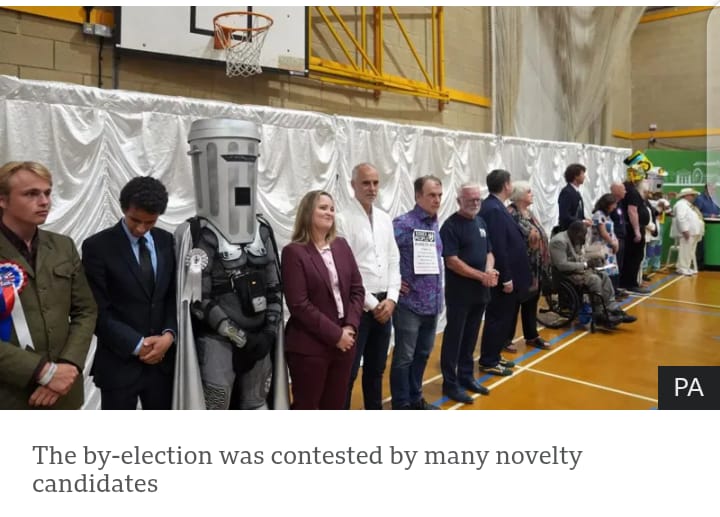
The contest attracted an unprecedented 34 candidates, although Labour, the Conservatives, Liberal Democrats, Greens and Restore Britain chose not to field contenders.
The parties described the election as a political stunt.
Farage was absent when the result was declared at Clacton Leisure Centre.
He said police had warned him about an alleged organised effort to disrupt proceedings and explained that he did not want to attend under those circumstances.
In a statement after the result, Farage described the outcome as a decisive rejection of the political establishment and said Clacton voters had delivered a strong endorsement of his political campaign.
The parliamentary standards watchdog subsequently confirmed that its investigation into the £5 million payment was no longer on hold.
The money came from businessman Christopher Harborne, a wealthy supporter of Reform UK.
The inquiry is examining whether Farage should have declared the financial benefit after receiving it before becoming an MP.
Should the investigation conclude that parliamentary rules were broken, Farage could face disciplinary action, including a possible suspension from the Commons.
Depending on the circumstances, this could ultimately lead to another contest for the Clacton seat.
Political opponents have also demanded scrutiny of financial assistance Farage allegedly received from another associate, George Cottrell, before the 2024 general election.
The by-election produced an unusual result for novelty candidate Count Binface, the alter ego of comedian Jonathan Harvey.
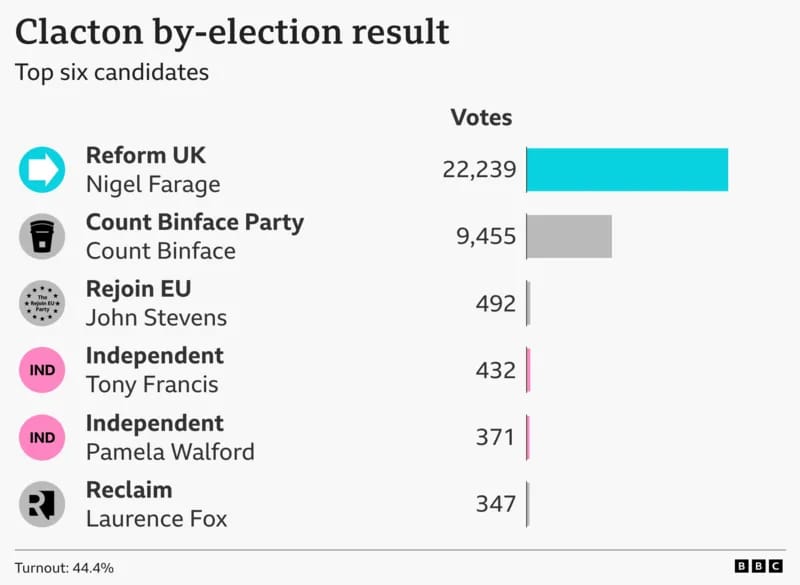
He secured 9,455 votes, equivalent to 26.9% of the vote, despite Farage’s absence from the count.
Count Binface later mocked Farage, claiming his own result demonstrated that a significant proportion of Clacton voters preferred him to the Reform leader.
Labour chairwoman Bridget Phillipson dismissed Farage’s victory, arguing that the election had failed to remove questions surrounding his financial affairs.
The Liberal Democrats said Farage had emerged from the contest looking foolish and urged parliamentary authorities to continue their investigation.
The Conservatives similarly described the election as artificial and argued that it had failed to resolve concerns over the £5 million payment.
The poll is estimated to have cost taxpayers approximately £250,000.
Reform UK offered to meet the expense, but political parties are prohibited from funding elections in order to protect the neutrality of the electoral process.
The unusually large field also created logistical difficulties for election officials.
Ballot papers stretched to about 90cm, requiring sizeable tables during the counting process.
Clacton’s 34-way contest surpassed the previous record of 26 candidates, established during the 2008 Haltemprice and Howden by-election.
Farage first entered Parliament in 2024 after winning Clacton with 46% of the vote.
His latest performance lifted his share by about 17 percentage points, although it remained below the 71.6% achieved by Conservative Sir David Davis in the 2008 contest.
By: Magdalene Agyeiwaa Sarpong