

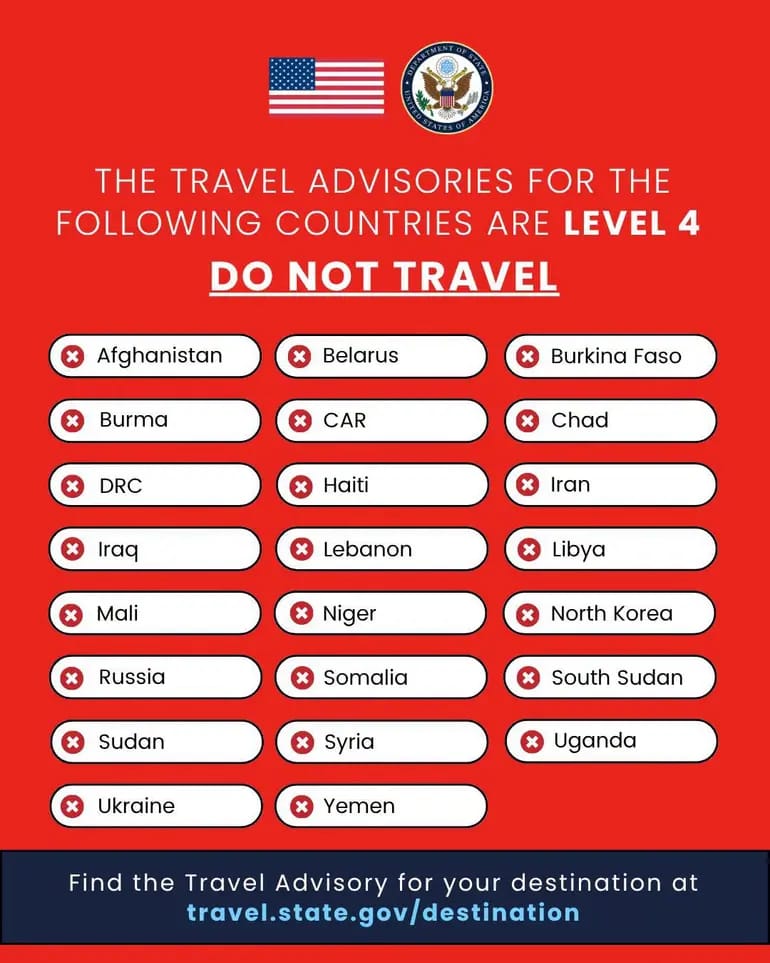
The United States has placed 11 African nations among 23 countries facing its highest travel restriction, warning American citizens to avoid visiting the destinations because of serious security threats and inadequate government assistance.
The US Department of State, through its Consular Affairs bureau, identified the affected territories under its Level 4 – Do Not Travel category.
The African nations affected include Burkina Faso, Central African Republic, Chad, Democratic Republic of the Congo, Libya, Mali, Niger, Somalia, South Sudan, Sudan and Uganda.
Outside Africa, the other countries facing the same restriction are Afghanistan, Belarus, Myanmar, Haiti, Iran, Iraq, Lebanon, North Korea, Russia, Syria, Ukraine and Yemen.
The American government operates a four-tier advisory system to inform citizens about potential dangers abroad.
Level 1 recommends standard safety measures, while Level 2 encourages heightened vigilance. Level 3 urges visitors to reconsider their journeys, whereas Level 4 represents the strictest warning against all travel.
According to the department, the highest classification is determined by prevailing security conditions or circumstances that could prevent US authorities from providing adequate support to their nationals.
Ghana, however, has escaped the most severe designation and remains under Level 2, requiring American visitors to exercise additional caution.
The advisory identifies criminal activities, inadequate medical facilities, attacks targeting women and hostility towards lesbian and gay travellers as major concerns.
Despite the country’s overall Level 2 status, Washington has singled out certain locations where visitors are encouraged to reconsider travelling.
These include border communities in the Upper East, North East and Upper West regions, alongside portions of the Savannah Region situated west of the N12 highway, largely because of criminal activity.
The report also draws attention to security incidents such as armed robbery, vehicle hijacking, street attacks, physical assault and sexual violence.
On healthcare, American authorities caution that medical services remain inadequate in several parts of Ghana, particularly beyond Accra. Visitors facing serious medical emergencies may therefore require transportation abroad for treatment.
Travellers have consequently been advised to maintain heightened awareness, avoid walking or driving alone at night, refrain from attracting attention through expensive possessions and obtain insurance policies that cover emergency medical evacuation.
Ghana’s Level 2 designation means the country is not subject to the blanket prohibition imposed on the 23 destinations.
Nevertheless, the identified security challenges and healthcare limitations remain important considerations for prospective American visitors.
By: Magdalene Agyeiwaa Sarpong