

Three convicted murderers in Tennessee, Alabama and Oklahoma are scheduled to be executed on Thursday, marking the first time in 16 years that three American prisoners could be put to death on the same day.
The planned capital punishments involving Anthony Darrell Hines, 66, Jeremy Williams, 41, and Carlos Cuesta-Rodriguez, 71, come as the number of executions in the United States continues to climb.
The US recorded 47 executions across 11 states in 2025, compared with 25 the previous year.
The figure was more than four times the number recorded in 2021.
Florida has accounted for a significant share of the increase.
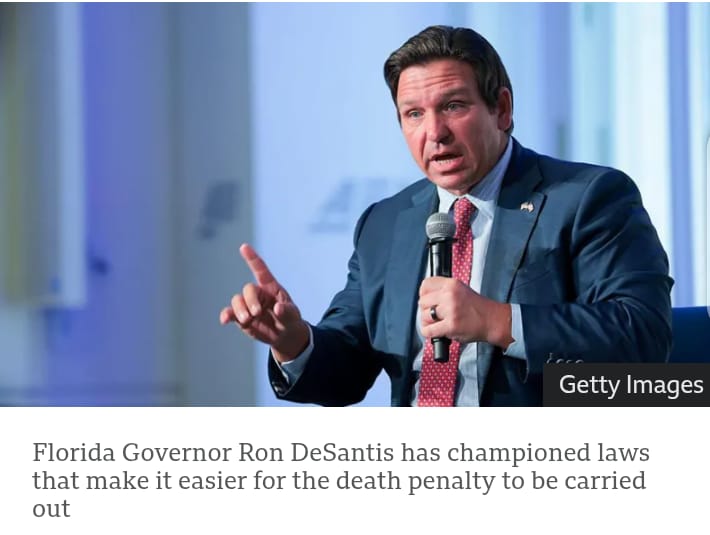
Twelve of the 19 executions carried out in the US so far in 2026 have taken place in the state, with experts pointing to Republican Governor Ron DeSantis as a major factor.
Robin Maher, executive director of the Death Penalty Information Center, said Florida’s policies have made it an exception among US states.
Under DeSantis, Florida has introduced measures that make capital punishment easier to impose.
In 2023, lawmakers reduced the number of jurors required to recommend a death sentence from all 12 to eight.
The state has also made sexual battery involving a child under 12 a capital crime.
DeSantis has defended capital punishment as an effective deterrent and a suitable response to the most serious offences.
President Donald Trump has also consistently supported executions.
During his first presidency, he ended a lengthy federal pause on capital punishment and oversaw 13 federal executions within six months.
After returning to office in 2025, President Trump signed an executive order restoring the federal government’s support for capital punishment.
His administration has since encouraged prosecutors to seek death sentences in cases involving the killing of law enforcement officers.
The Justice Department has additionally expanded approved execution methods and moved to accelerate procedures surrounding capital cases.
However, no federal prisoner has been executed since President Trump’s latest order.
The federal government and individual states can independently impose the death penalty, meaning state governors retain considerable influence over whether condemned prisoners are ultimately executed.
Despite the recent increase, public backing for capital punishment has weakened.
Gallup polling indicates that only 52% of Americans now regard the death penalty as morally acceptable, representing its lowest level since the 1970s.
The number of new death sentences has also fallen sharply.
During the 1990s, American juries regularly handed down more than 300 death sentences annually.
In 2025, the figure dropped to just 23.
Death penalty opponents say the declining number of sentences demonstrates a broader change in public attitudes.
Justin Mazzola, deputy research director at Amnesty International USA, said President Trump’s influence on the number of executions would take years to fully assess because capital cases generally involve lengthy trials and multiple stages of appeals.
Questions over execution methods have also intensified the controversy. Pharmaceutical manufacturers have resisted having their medicines used for lethal injections, contributing to shortages.
South Carolina responded to a shortage in 2025 by using firing squads to execute prisoners.
Concerns have further emerged over failed and prolonged executions.
According to the Death Penalty Information Center, approximately 3% of executions between 1890 and 2010 were considered botched, while lethal injection recorded the highest failure rate.
The organisation reported that more than one-third of US executions in 2022 were botched or involved serious complications.
Tennessee recently faced criticism after prison officials struggled for more than an hour to establish intravenous access during an attempted execution of Tony Von Carruthers.
Witnesses said he appeared to experience pain during the procedure.
Governor Bill Lee later granted him a one-year reprieve, although he rejected the description of the incident as a botched execution.
Hines is due to face the same execution procedure in Tennessee.
The 66-year-old, who has maintained his innocence for years, is reportedly bedridden.
In Alabama, Williams is scheduled to die by lethal injection after being convicted of raping and killing a five-year-old girl in 2021.
He has chosen not to continue pursuing legal challenges and has indicated that he does not want clemency.
Governor Kay Ivey has said she does not intend to intervene.
Cuesta-Rodriguez, 71, is scheduled for execution in Oklahoma over the 2003 killing of a woman. He has also declined to seek mercy.
His advanced age has prompted concerns about the possibility of complications during the procedure.
The United States remains one of the few Western nations where capital punishment is still permitted.
Across the country, 27 states retain death-penalty statutes, although California, Ohio, Oregon and Pennsylvania have halted executions through executive action.
Critics have raised concerns about racial disparities, expenses, wrongful convictions and failures during executions.
Maya Foa, chief executive of Reprieve US, argued that capital punishment is neither a simple nor inexpensive response to serious crime.
Supporters, however, continue to defend the practice.
Florida prosecutors have pursued death sentences in several high-profile murder cases, arguing that individuals responsible for particularly brutal crimes deserve the harshest available punishment.
The three scheduled executions on Thursday therefore come at a significant moment for America’s death penalty system, executions are increasing in several jurisdictions even as public approval and the number of new death sentences continue to decline.
Whether all three prisoners will ultimately be put to death remains uncertain, as courts can still intervene and governors may grant last-minute reprieves.
By: Magdalene Agyeiwaa Sarpong