

Ukraine is facing growing political tension as uncertainty over the country’s military leadership deepens following President Volodymyr Zelensky’s decision to remove Defence Minister Mykhailo Fedorov, a move that has triggered public demonstrations and intensified calls for changes within the armed forces.
Organisers of the nationwide rallies have warned that they will resume protests indefinitely if Commander-in-Chief Gen.
Oleksandr Syrskyi remains in office and Fedorov is not reinstated as defence minister by Friday, July 24.
For now, no further demonstrations have been scheduled as the country awaits the president’s next move.
Over the past few days, President Zelensky has held consultations with senior government officials and military commanders in an effort to resolve the standoff.
The discussions have fuelled widespread speculation, including unconfirmed reports that Syrskyi was about to be dismissed.
Ukraine’s General Staff rejected those claims, while separate reports suggested Fedorov had declined another government appointment.
The head of the presidential office, Kyrylo Budanov, appealed for restraint, acknowledging public concern while urging citizens to avoid internal divisions that could benefit Russia.
He assured Ukrainians that authorities had taken note of public opinion and that efforts were underway to address the situation.
Much of the public criticism has centred on Gen. Syrskyi, whom many protesters accuse of relying on outdated military thinking.
Responding to the backlash, the army chief defended his leadership in a published article, dismissing suggestions of a personal feud with Fedorov and insisting their relationship had always been professional.
He also apologised if his actions had caused offence.
Syrskyi argued that military reforms, procurement decisions and mobilisation policies require careful planning rather than public pressure, stressing that battlefield success depends on practical action instead of political slogans.
Without naming Fedorov directly, he also criticised what he described as excessive public presentations, saying military decisions must be supported by proper planning, financing and procedures.
Despite his defence, many Ukrainians continue to support Fedorov, who is widely credited with accelerating military innovation and modernising the country’s defence strategy during his six-month tenure.
Supporters believe his emphasis on technology, particularly drone warfare, has strengthened Ukraine’s ability to resist Russian forces.
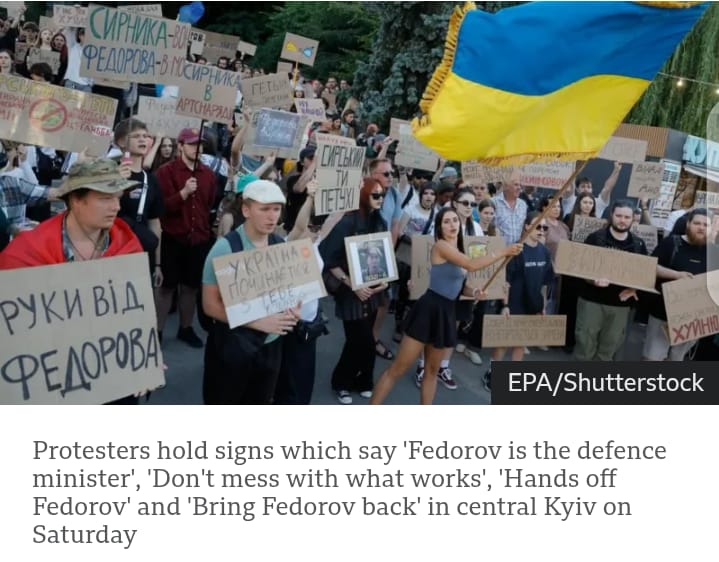
Speaking during recent demonstrations, several protesters argued that Ukraine’s military must move beyond Soviet-era doctrines and embrace a more modern approach to warfare.
They said recent battlefield gains had boosted confidence that change was possible under Fedorov’s leadership.
Addressing criticism that he had failed to modernise the armed forces, Syrskyi pointed to the creation of a dedicated unmanned systems branch, while maintaining that drones alone could not replace conventional military capabilities in a force numbering around one million personnel.
As debate over the military’s future continues, attention has shifted to possible successors should Zelensky decide to replace the commander-in-chief.
Names reportedly under consideration include Joint Forces Commander Mykhailo Drapaty, Third Army Corps Commander Andriy Biletsky, Airborne Assault Forces Commander Oleh Apostol, National Guard Corps Commander Ihor Obolensky and Brig.
Gen. Denys Prokopenko, the former Azov Regiment commander who returned to active service after his release in a prisoner exchange with Russia.
President Zelensky has indicated that consultations on Ukraine’s defence strategy are ongoing, saying the country must strengthen its military position ahead of an expected escalation in Russian attacks on critical energy infrastructure later this year.
Although the streets have temporarily fallen quiet, the political crisis remains unresolved as Ukrainians await key decisions that could reshape the country’s military leadership and wartime strategy.
By: Magdalene Agyeiwaa Sarpong