

A Libyan man accused of involvement in the 1988 Lockerbie bombing has asked a US court to dismiss his case, arguing that he was forcibly taken from his home country and transferred to American authorities unlawfully.
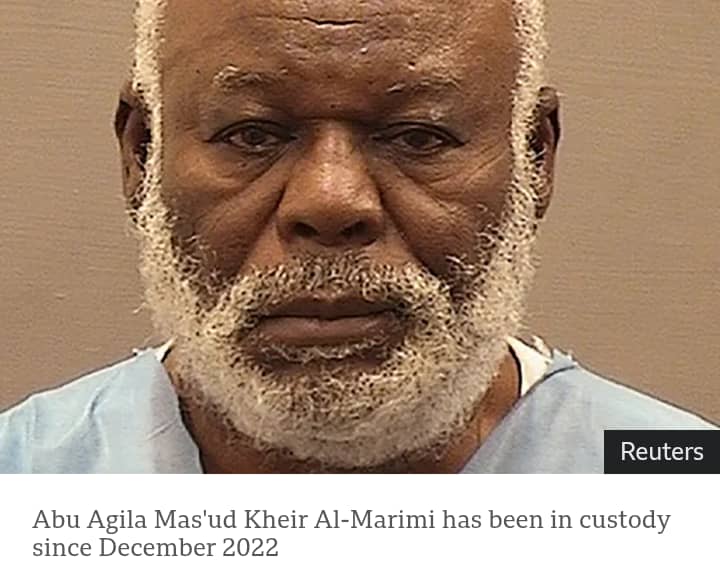
Abu Agila Mohammad Mas’ud Kheir Al-Marimi, popularly known as Mas’ud, alleges that armed men seized him during a secret nighttime operation and delivered him to Federal Bureau of Investigation (FBI) officers while hooded and restrained.
He denies assembling and preparing the explosive device that destroyed Pan Am Flight 103 over Lockerbie, Scotland, on December 21, 1988.
The disaster claimed 270 lives.
In court documents, his defence team maintains that the circumstances surrounding his transfer violated Libyan sovereignty and amounted to an illegal abduction. They are seeking to have the proceedings terminated.
However, the US Department of Justice argues that the circumstances of a defendant’s arrival in the country do not automatically prevent American courts from exercising jurisdiction.
Prosecutors insist that the case should proceed, with the trial scheduled for January following three postponements.
The allegations surrounding Mas’ud’s transfer were outlined in recently submitted legal documents.
Washington indicted him in December 2020 and subsequently sought his extradition or another legally acceptable means of transferring him from Libya.
At the time, Mas’ud was imprisoned for offences connected to attacks against rebel fighters during the 2011 uprising against former Libyan leader Muammar Gaddafi.
He claims he was released on compassionate grounds on September 30, 2021, and returned to his family in Tripoli.
Approximately two weeks later, armed individuals, many wearing masks, allegedly stormed his residence and detained him without explaining their identities or the reason for his arrest.
His lawyers accuse a militia group known for alleged human rights abuses of carrying out the operation.
They further claim that Mas’ud was dragged along the floor despite his mobility difficulties, while his son was struck with a rifle and his wife and daughter were assaulted.
The defence alleges that he was subsequently transported to a detention facility in Misrata, approximately 187 kilometres east of Tripoli, where he spent several days in isolation.
According to his account, on December 11, 2022, prison officials provided him with food and tea before instructing him to gather his belongings. Although he believed his detention was ending, he was instead transferred to American agents.
A US aircraft was reportedly stationed at Misrata airport when he arrived with a loosely secured cloth covering his head. His escorts allegedly urged FBI personnel to complete the handover quickly because members of the public were observing the operation.
His belongings, including a Quran, prayer mat, clothes, toiletries and medication, were reportedly delivered in a plastic refuse bag.
During the journey to the United States, FBI officers questioned him, conducted a medical examination and supplied fresh clothing and blankets, according to his legal representatives.
The defence also alleges that Libyan Prime Minister Abdulhamid Dbeibah subsequently obtained American financial support, including $16 million intended to assist Libya’s democratic transition, alongside a business agreement involving US energy company Honeywell International.
Mas’ud’s lawyers argue that the alleged operation was conducted after diplomatic discussions failed, demonstrating disregard for Libyan legislation and national independence.
They contend that the circumstances warrant his return to Libya, insisting that powerful governments should not be permitted to bypass legal procedures when seeking suspects abroad.
In response, American prosecutors maintain that established legal principles allow courts to retain authority over defendants regardless of how they were brought before them, including cases involving alleged forcible transfers.
The government further argues that the limited legal exceptions to this principle are irrelevant to Mas’ud’s situation.
It also maintains that the alleged conduct of Libyan militia members cannot be attributed to the United States, as required for the defence’s argument to succeed.
His lawyers have requested a hearing before Judge Dabney Friedrich to present their objections.
Mas’ud’s transfer to American custody in 2022 triggered considerable controversy in Libya.
Prime Minister Dbeibah defended his administration’s actions, stating that authorities had cooperated with international judicial arrangements for the extradition of citizens facing criminal accusations.
At the time, an Interpol red notice was active against Mas’ud, requesting that law enforcement agencies worldwide locate and provisionally arrest him pending extradition or surrender.
Dorothy Bain KC, who was then Scotland’s Lord Advocate and head of the country’s prosecution service, informed the Scottish Parliament that she had received assurances that Mas’ud had been transferred to US custody on a lawful basis.
By: Magdalene Agyeiwaa Sarpong