

US Files Murder Charges Against Cuba’s Raúl Castro Over 1996 Plane Shootdown/ Image@ BBC
The United States has formally charged former Cuban leader, Raúl Castro with conspiracy to kill American citizens and other serious offenses related to the 1996 downing of two planes traveling between Cuba and Florida.
The case, revealed on Wednesday, accuses Castro and five accomplices of shooting down aircraft belonging to the Cuban-American organization Brothers to the Rescue, resulting in the deaths of four individuals, including three Americans.
At 94 years old, Castro was the head of Cuba’s armed forces at the time of the incident and faced widespread international criticism following the crash.
In response to the charges, Cuban President, Miguel Díaz-Canel denounced them as “a political maneuver, lacking any legal basis.”
During a press conference at Freedom Tower in Miami, Acting Attorney General, Todd Blanche, announced additional charges against Castro for destruction of aircraft and four counts of murder concerning the deaths of Armando Alejandre Jr., Carlos Alberto Costa, Mario Manuel de la Peña, and Pablo Morales.
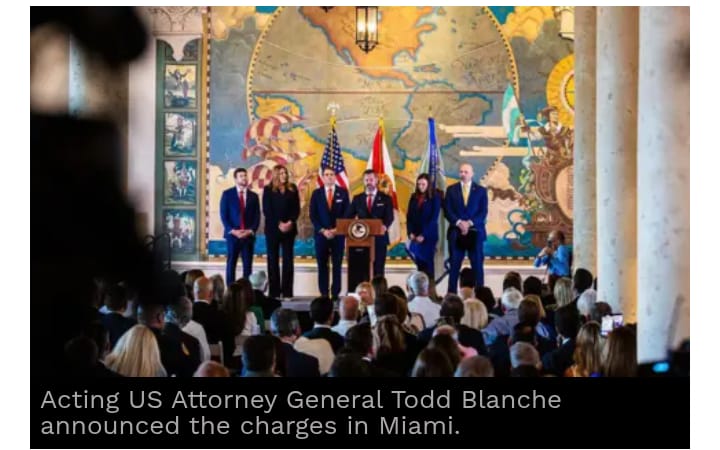
”The United States, and President Donald Trump, does not, and will not, forget its citizens,” Blanche stated.
These charges will be addressed in a US court, with some carrying potential life sentences. Each murder charge could result in the death penalty or life imprisonment.
The Justice Department’s latest actions target a prominent figure in Cuba’s communist regime as the US intensifies pressure for significant political and economic reforms within the island’s one-party system.
William LeoGrande, a Latin American politics expert at American University, noted that the strategy appears to be gradually increasing pressure until the Cuban government is compelled to negotiate.
The US has implemented sanctions against Cuba and enforced an oil blockade, leading to widespread blackouts and food shortages on the island.
Earlier on Wednesday, US Secretary of State, Marco Rubio, delivered a message to the Cuban populace coinciding with their independence day celebrations.
”President Donald Trump is offering a new path between the US and a new Cuba,” Rubio stated. He attributed the ongoing blackouts and food scarcity primarily to GAESA, a military-run conglomerate that dominates much of Cuba’s economy.
In response to Rubio’s remarks, Díaz-Canel accused the US of spreading falsehoods and imposing collective punishment on the Cuban people.
He further asserted that Castro’s indictment was being utilized to “justify the folly of military aggression against Cuba” and contended that Cuba acted in “legitimate self-defense within its territorial waters.”
When questioned about the possibility of bringing Castro to the US to face charges, Blanche confirmed that there is an arrest warrant for him but did not disclose whether efforts would be made to capture him. He remarked, “We expect he will show up here, by his own will or another way.”
American University’s LeoGrande expressed his belief that the US is prepared to apprehend the former Cuban leader “if the Cubans do not concede at the negotiation table.”
In January, the US executed a military operation aimed at capturing former Venezuelan President, Nicolás Maduro, and extraditing him to the US following an indictment from the Justice Department.
This action significantly altered Venezuela’s dynamics with Washington, though LeoGrande warned that a similar outcome in Cuba is improbable, given that Castro stepped down nearly a decade ago.
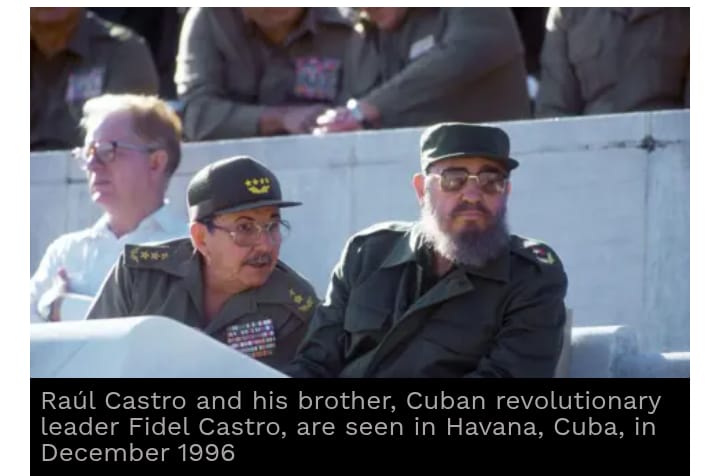
Now approaching 95 years old, Castro, the sibling of the late Fidel Castro, continues to hold sway as a prominent figure recognized on the island as the last “leader of the Cuban Revolution.”
While he has stepped back from active governmental and party responsibilities, during his presidency from 2008 to 2018, he and former US President Barack Obama oversaw a brief warming of relations between Washington and Havana.
Blanche remarked that he would “not draw parallels” between Castro’s situation and that of Maduro.
When asked about the political implications of Wednesday’s indictment, President Donald Trump stated, “Many of those individuals are connected to me through my strong ties with Cuban-Americans. On humanitarian grounds, we are here to assist.”
The Miami venue where US officials revealed the indictment of Raúl Castro was filled with Cuban Americans, primarily representing exile groups that have long opposed the Cuban government from within the United States.
Amidst photographs of the four victims from the 1996 incident, many attendees at the Miami event expressed their excitement over the announcement.
”It was overdue, 67 years under that brutal regime,” Isela Fiterre declared.
”Raúl Castro didn’t just take the lives of four individuals. Over many years, he has caused countless deaths,” she asserted.
Fiterre emphasized that it is never too late for justice and expressed her gratitude to the Trump administration for taking this significant step.
By: Magdalene Agyeiwaa Sarpong