

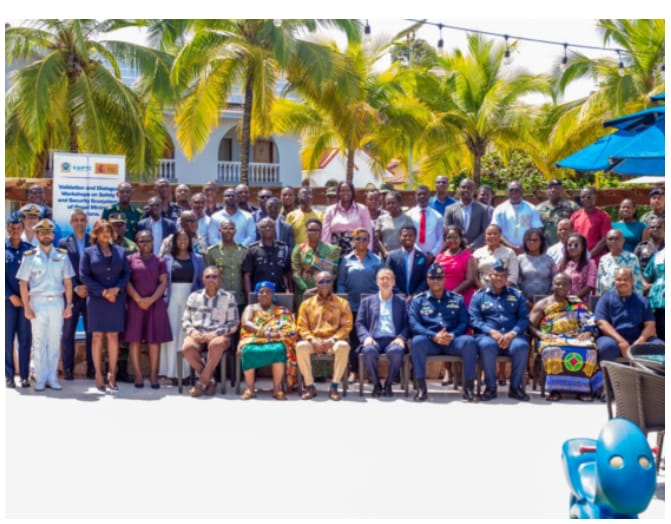
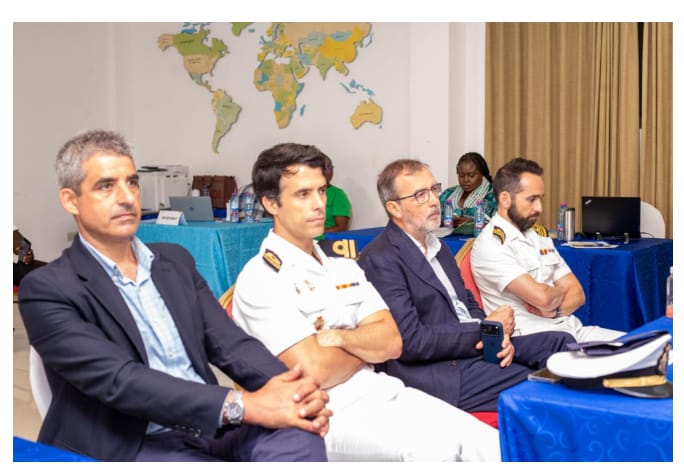
The Kofi Annan International Peacekeeping Training Centre (KAIPTC), in collaboration with the Embassy of Spain in Accra yesterday, delivered the Western Regional Validation and Dialogue Workshop on the Safety and Security Ecosystem of Illegal Mining.
The event gathered a wide range of stakeholders, including officials from the National Commission on Small Arms and Light Weapons, the National Peace Council, the Minerals Commission, chieftaincy and defense sectors, as well as the former Commander of the Vanguard and the Director of NAIMOS.
Held at the Raybow International Hotel in Sekondi-Takoradi, the event followed thorough field research conducted across the Ashanti and Western regions and their nearby mining corridors. The findings revealed that illegal mining, commonly known as “galamsey,” has evolved from essentially informal livelihood activity into a deeply rooted political, social, and economic ecosystem.
Sustained by support networks, investments-driven methods, and inadequate supervision, illegal mining now influences local and regional governance, impacting land authority, labor relations, and community safety.
Research findings indicate that insecurity associated with galamsey manifests not only through visible crime and violence but also through persistent fear, declining access to clean water and arable land, and perceptions of selective enforcement influenced by political and economic interests.
Women and children are particularly vulnerable, often involved in dangerous ore processing or other mining-related labor that exposes them to health risks, exploitation, and long-term social harm.
At the organizational level, district assemblies, regulatory agencies, and security services function within a scattered governance landscape defined by limited resources, political sensitivities, and unclear mandates. This fragmentation has resulted in inconsistent enforcement and public awareness of limited state capacity.
Spanish Ambassador to Ghana, Ángel Lossada Torres-Quevedo, highlighted the need for international cooperation during his opening remarks. He noted the partnership between the Spanish Embassy and KAIPTC, stating, “The safety and security of this country is also part of the safety and security of Spain.”
Ambassador Lossada Torres-Quevedo emphasized the necessity of a holistic approach, acknowledging that galamsey includes social, economic, and environmental aspects. While KAIPTC leads operational initiatives on the ground, the Embassy provides strategic support to ensure all stakeholders, including regional partners, are engaged in organized interventions.
Commandant of KAIPTC, Air Vice Marshal David A. Akrong, referred to the Western Region as “the heart of Ghana’s contemporary mining economy,” pointing out its dense concentration of formal mining operations, transport corridors, coastal and inland communities, and cross-border commercial networks.
He cautioned that illegal mining has become a “complex political and economic ecosystem” affecting land access, labor relations, and community safety while challenging the effectiveness and collaboration of state institutions.
Communities are caught in a delicate balance between immediate income needs and the long-term consequences of environmental degradation and social disruption.
Air Vice Marshal Akrong concluded by raising concerns about the growing link between illegal mining and illicit weapons circulation, which poses risks for both local communities and frontline security personnel. He called for stronger governance, more accountable security measures, and community-focused strategies to address these risks.
By: Magdalene Agyeiwaa Sarpong