

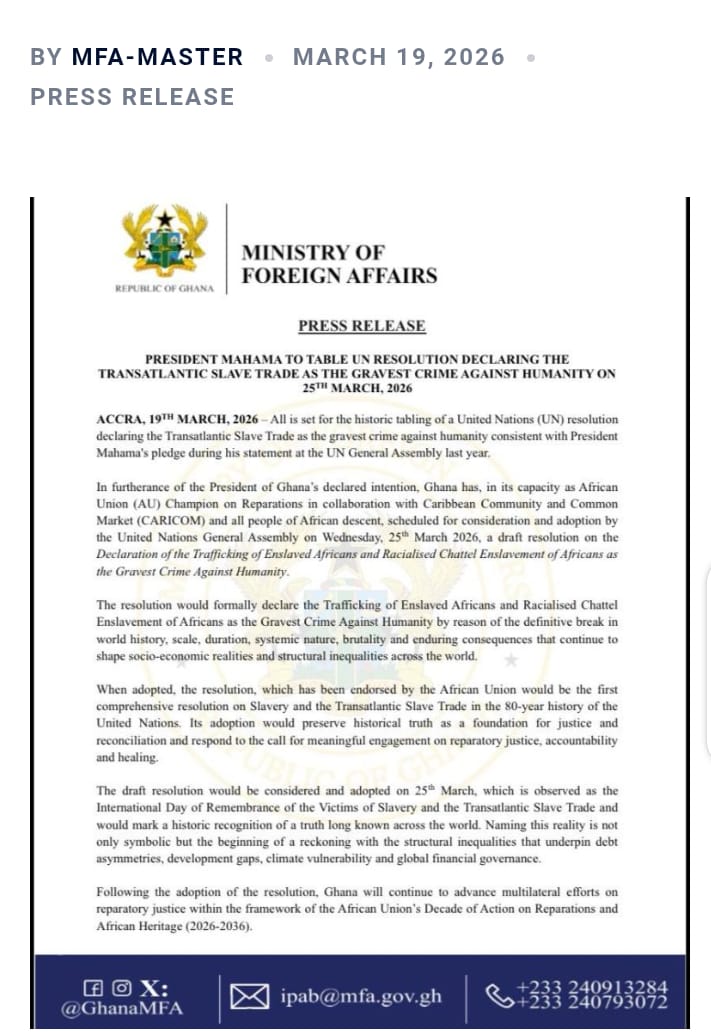
The Ministry of Foreign Affairs in Ghana in a press statement today announced that, the country will present a significant resolution at the United Nations General Assembly, aiming to declare the Transatlantic Slave Trade as the gravest crime against humanity.
The initiative, spearheaded by Ghana’s President John Dramani Mahama, is planned for discussion and potential adoption on Wednesday, March 25, 2026, corresponding with the International Day of Remembrance of the Victims of Slavery and the Transatlantic Slave Trade.
Ghana is advancing this resolution in its capacity as the African Union Champion on Reparations, in cooperation with the African Union and the Caribbean Community (CARICOM), as well as with people of African descent worldwide.
The resolution seeks to formally recognize the trafficking of enslaved Africans and the racialized chattel enslavement of Africans as the most severe crime against humanity due to its unprecedented historical impact, scale, duration, systemic brutality, and lasting consequences.
If adopted, it would represent the first extensive United Nations resolution addressing slavery and the Transatlantic Slave Trade in the organization’s 80-year history. The Ministry stated that the initiative aims to “preserve historical truth as a foundation for justice and reconciliation” while responding to increasing demands for reparatory equality, responsibility, and healing.
In preparation for this momentous occasion, a wreath-laying ceremony will take place at the African Burial Ground in New York on March 24, followed by an executive event focused on reparatory equality at the United Nations.
The Ministry conveyed gratitude to various institutions and experts, including United Nations Educational, Scientific and Cultural Organization (UNESCO), the Community of Latin American and Caribbean States, and several African Union bodies, for their inputs to drafting the resolution.
Ghana has called on all UN member states to help this initiative, explaining it as a pivotal step in promoting global justice and addressing the enduring impacts of slavery. Following the resolution’s consideration, Ghana plans to continue advocating for reparatory equality as part of the African Union’s Decade of Action on Reparations and African Heritage (2026–2036).
By: Magdalene Agyeiwaa Sarpong