

South African President Cyril Ramaphosa has secured a major legal victory after the Western Cape High Court annulled an investigative report linking him to alleged misconduct following a cash robbery at his private residence.
The court declared the findings of an independent parliamentary panel invalid, ruling that the investigators had exceeded their legal authority and committed significant errors in interpreting their mandate.
The controversial report, released in 2022, raised concerns about the disappearance of $580,000 from Ramaphosa’s Phala Phala game farm in Limpopo. It suggested that the president had questions to answer regarding the incident, an allegation he strongly rejected.
Delivering the judgment, Justice Nolwazi Mabindla-Boqwana stated that the panel had misunderstood its responsibilities and the scope of the investigation. Consequently, the entire document was overturned. The court also invalidated parliamentary actions arising from the findings.
Political commentator Khanyi Magubane described the decision as an important boost to Ramaphosa’s political standing and constitutional position. However, she stressed that the judgment did not establish his innocence or guilt in relation to the underlying criminal allegations.
She noted that although the ruling offers the president considerable relief, the controversy surrounding the farm incident could continue to affect his reputation.
The judgment effectively undermines the foundation of the impeachment process initiated against Ramaphosa, although opposition groups are reportedly considering further legal action.
The controversy, popularly known as the Farmgate scandal, became public in 2022 after former intelligence chief Arthur Fraser submitted a complaint to law enforcement authorities. He accused the president of concealing the burglary and failing to report the stolen funds to the relevant agencies.
The incident occurred in 2020 when unidentified individuals reportedly broke into the property and removed bundles of American currency concealed inside a couch. Two individuals were convicted earlier this month for their involvement in the burglary.
Ramaphosa acknowledged the incident but maintained that the missing money originated from a lawful transaction involving the sale of buffaloes through his livestock enterprise.
Although several separate investigations reportedly found no evidence of wrongdoing against him, Parliament initiated removal proceedings and established an independent committee to examine the allegations.
The investigators subsequently questioned the credibility of the money’s origin and concluded that the president had matters to address.
President Ramaphosa initially sought judicial intervention but abandoned the case after lawmakers rejected the panel’s recommendations. He returned to court in May this year following a Constitutional Court decision that found Parliament had acted contrary to the Constitution by preventing further impeachment procedures.
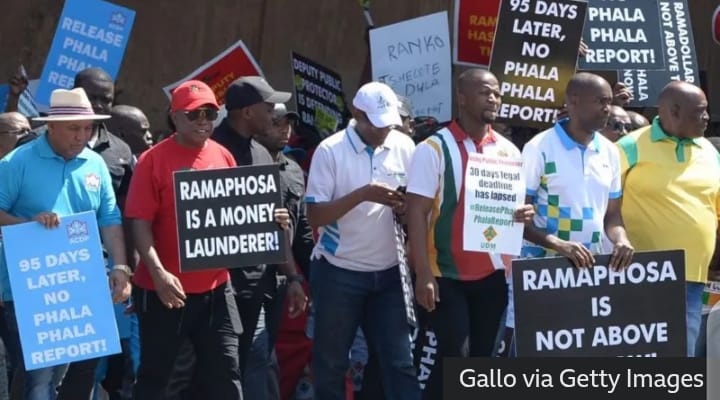 Opposition parties, pictured above, have been vocal in their call for the president to account for his role in the saga
The apex court directed lawmakers to submit the report to a special committee for consideration.
In his renewed application, the president maintained that the investigators had misunderstood their assignment, improperly assessed the available evidence and wrongly interpreted the accusations brought against him.
The latest ruling could terminate the parliamentary removal process unless opponents successfully overturn the decision through an appeal.
Should an appeal succeed, the impeachment committee could resume examining the allegations and submit its recommendations to Parliament. Any eventual decision to remove the president would require approval from at least two-thirds of lawmakers.
However, Ramaphosa’s African National Congress (ANC) currently holds sufficient parliamentary representation to prevent such a threshold from being reached.
He remains the first South African head of state to undergo impeachment proceedings under the framework established in 2018.
By: Magdalene Agyeiwaa Sarpong