

The killing of 13 women around Johannesburg earlier this year sparked a national outcry
South Africa has recorded 581 killings of women between July and September 2026, with fresh police figures highlighting the continued severity of gender-based violence across the country.
The statistics, published on Friday, indicate that Gauteng Province, which includes Johannesburg, accounted for 131 of the recorded fatalities.
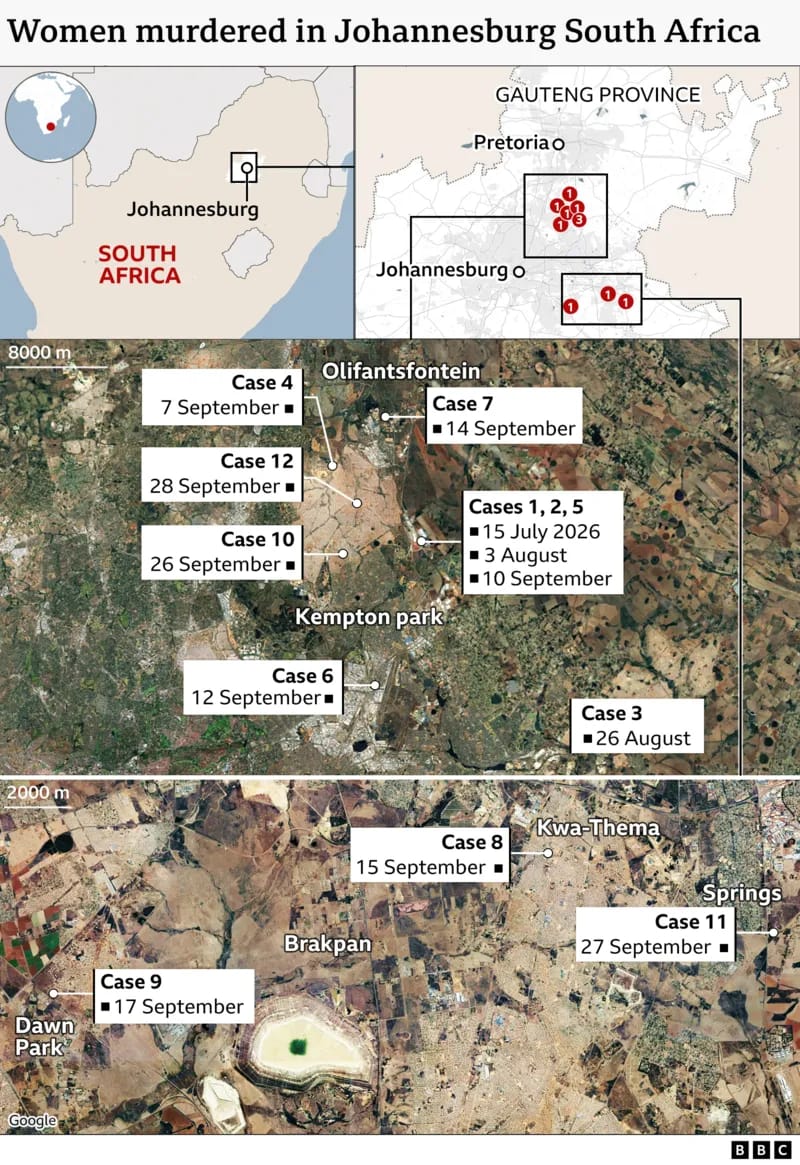
Among the victims were 13 women whose battered, partially unclothed remains were discovered in different public locations around Johannesburg, sparking widespread condemnation and demands for swift investigations.
Public anger has intensified following another deadly incident in the Free State, where five women and a young child were shot dead earlier this week.
Despite the alarming number of female victims, the country’s overall homicide figures showed a modest improvement. Police documented 5,590 murders during the three-month period, representing 204 fewer cases than the corresponding period last year.
However, the latest tally still translates into approximately 60 killings every day.
Authorities have not established whether female homicide cases have risen or fallen compared with previous periods, as law enforcement agencies had temporarily discontinued publishing separate figures because of what they described as substantial statistical inconsistencies.
Acting Police Minister Firoz Cachalia has called for stronger preventive interventions to protect women and children from violent attacks.
In the latest Free State incident, police said three unidentified gunmen stormed a family residence in Botshabelo township on Wednesday night.
According to investigators, the assailants were searching for the property’s owner. After discovering that he was absent, they allegedly entered the building forcibly and opened fire on the occupants.
The man’s wife sustained a gunshot wound to her abdomen and was transported to hospital for treatment. No suspects had been apprehended in connection with the attack at the time of reporting.
Meanwhile, Gauteng Provincial Police Commissioner General Tommy Mthombeni disclosed that eight individuals had been arrested in connection with the series of 13 female killings that generated nationwide outrage.
Three of the detainees are linked to the death of 38-year-old Elizabeth Moselakgomo, whose disappearance prompted an extensive public search after she failed to return from her regular jogging session near her Kempton Park residence.
Her severely injured body, which was partially unclothed, was recovered on September 12.
Mthombeni also confirmed that two suspects had been taken into custody over the killing of 33-year-old Jabulile Ntimba. Her remains were discovered wrapped in a bedsheet beside a roadway in Boksburg on September 17.
Ntimba was the ninth victim whose body was recovered within the Ekurhuleni area.
Another individual has been detained over a separate homicide in Kempton Park, while an additional suspect faces investigation over the death of Ntombifuthi Nxumalo in Tembisa, located north-east of Johannesburg’s central business district.
Nxumalo was discovered at a burial ground on September 26, bearing severe injuries to her head, with stones reportedly found close to her remains.
Police also confirmed an earlier arrest in July concerning the killing of Busisiwe Mahlangu, whose body was recovered in Kempton Park on July 15. She was the first among the 13 victims discovered in the area.
The disturbing incidents have renewed scrutiny of South Africa’s efforts to tackle violence against women, despite repeated government assurances to strengthen public protection.
President Cyril Ramaphosa pledged in September that investigators would pursue every available lead to identify and prosecute those responsible for the killings.
Last year, the South African leader classified violence against women as a national disaster, underscoring the seriousness of the country’s ongoing gender-based violence crisis.
By: Magdalene Agyeiwaa Sarpong