

Image@ BBC
China has condemned Washington’s decision to expand economic restrictions on Iran and businesses dealing with Tehran, warning that it would take steps to defend its commercial interests.
Chinese Foreign Ministry spokesperson Lin Jian said Beijing opposed what it described as unilateral measures imposed by the United States and insisted that its dealings with Iran complied with international law.
His comments came after US Treasury Secretary Scott Bessent unveiled a major new sanctions campaign on Monday, targeting Iranian financial networks, oil traders and those helping the country bypass existing restrictions.
Bessent warned that banks and companies maintaining financial links with Tehran could face exclusion from the US-led financial system.
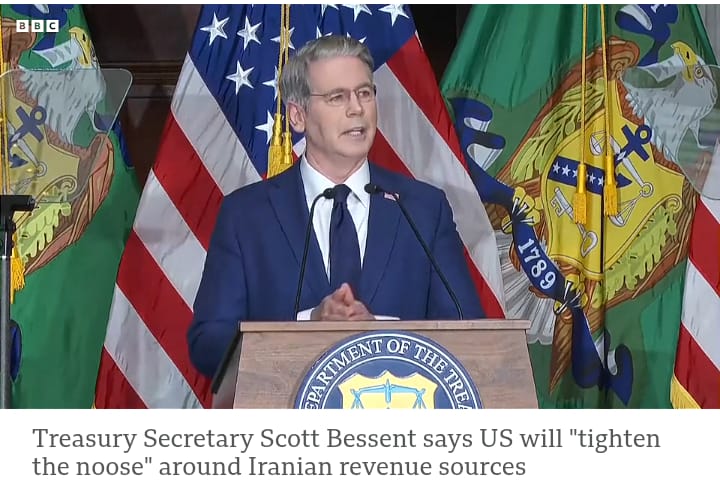
Asked specifically about Chinese financial institutions, he said no country or business was beyond Washington’s sanctions regime.
China is Iran’s principal customer for crude oil, with a large share of Tehran’s petroleum exports heading to Chinese buyers despite years of American pressure.
Beijing’s firm response could increase tensions between the world’s two largest economies, particularly as US President Donald Trump and Chinese leader Xi Jinping are expected to hold talks next month.
Washington may also be concerned about possible countermeasures from China, which dominates the processing of rare earth elements and other strategic minerals needed for advanced technologies.
Beijing has previously restricted exports of some of these materials during disputes with the US.
Iran has also rejected the threat posed by the expanded restrictions.
Economy Minister Ali Madanizadeh said Tehran had anticipated the move and had prepared a two-year strategy to withstand the pressure.
The American administration has labelled the campaign “Operation Economic Outcast”, describing it as an unprecedented financial assault intended to cut Iran off from international commerce.
The measures come nearly six months into the conflict involving Iran, which has disrupted global energy markets.
Oil prices have risen amid restrictions on shipments through the Strait of Hormuz, one of the world’s most important maritime routes.
Diplomatic efforts to bring the confrontation to an end have so far failed, while a 60-day truce ended last week without producing a lasting agreement.
Bessent said Washington was now seeking to dismantle Iran’s economic networks rather than simply contain the threat.
The Treasury Department said it had identified numerous companies, individuals and vessels allegedly involved in helping Tehran circumvent restrictions.
However, some experts have questioned whether the latest package will significantly reduce Iran’s oil income.
David Oxley, chief climate and commodities economist at Capital Economics, said the immediate effect on Iranian petroleum exports was likely to be limited, largely because China remains a major destination for the country’s crude.
Ali Vaez, deputy director of the Middle East and North Africa programme at the International Crisis Group, said Beijing had historically rejected sanctions imposed independently by Washington.
He also argued that countries bordering Iran, including Pakistan, Turkey and Iraq, would find it difficult to sever their economic links with Tehran despite their relationships with the United States.
India and Russia, which also maintain commercial ties with Iran, had yet to publicly respond to Washington’s latest announcement.
By: Magdalene Agyeiwaa Sarpong