

Washington has imposed sweeping financial sanctions on the former president of the Democratic Republic of the Congo Joseph Kabange Kabila, accusing him of bankrolling armed groups seeking to unseat the government in Kinshasa — a move that deepens international pressure on actors fuelling one of Africa’s most protracted conflicts.
The U.S. Department of the Treasury’s Office of Foreign Assets Control announced the measures on Thursday, targeting Kabila for allegedly backing the March 23 Movement and its political-military wing, the Congo River Alliance. The Treasury said Kabila had provided financial support to the coalition and actively encouraged soldiers of the Armed Forces of the DRC to defect and join rebel ranks in the country’s volatile east. He also reportedly attempted, without success, to launch attacks on government forces from outside the DRC.
Under the sanctions, all of Kabila’s property and interests in property within the United States or under the control of U.S. persons are frozen, and American entities are barred from conducting any transactions involving his assets.
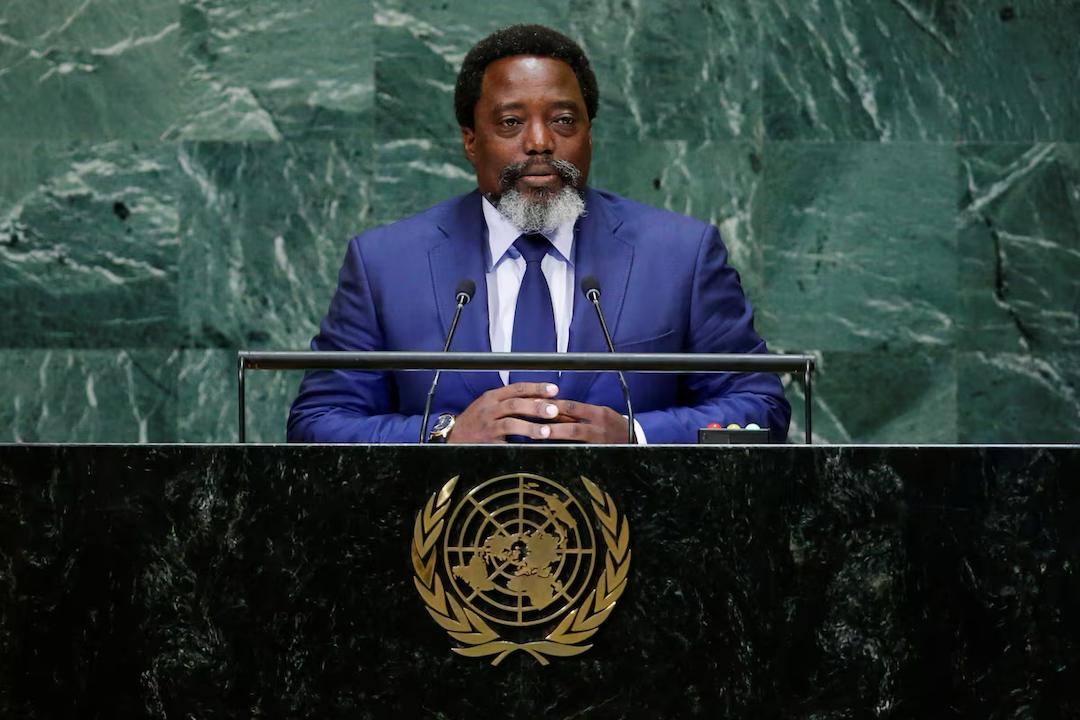 Joseph Kabila Kabange addresses the 73rd session of the United Nations General Assembly at U.N. headquarters in New York, U.S., September 25, 2018. REUTERS/Eduardo Munoz/File Photo
Treasury Secretary Scott Bessent framed the action as part of a broader push for regional stability. “President Trump is paving the way for peace in the Democratic Republic of the Congo, and he has been clear that those who continue to sow instability will be held accountable,” he said.
The sanctions are tied to the Washington Accords for Peace and Prosperity, a framework signed by the heads of state of the DRC and Rwanda on December 4, 2025, which Washington has positioned as a cornerstone of its peacemaking efforts in the region.
Kabila’s alleged ties to the M23 rebellion are not new to Kinshasa. The DRC government has long accused the former leader of supporting the Rwanda-backed militia, which has captured vast swathes of territory in eastern Congo — including the North and South Kivu provincial capitals of Goma and Bukavu — with direct military, financial and logistical backing from the Rwanda Defence Force. The RDF itself was sanctioned by Washington on March 2, 2026.
The accusations against Kabila culminated last year in a military court in Kinshasa sentencing him to death in absentia on charges of war crimes, treason and crimes against humanity, all linked to his alleged support for the rebels. Kabila has denied the charges, dismissing the proceedings as politically motivated.
Kabila ruled the DRC for nearly two decades, from 2001 until 2019, only relinquishing power after deadly street protests demanded his exit. He had extended his constitutionally mandated second term beyond its 2016 deadline by repeatedly postponing elections. Since late 2023, he has largely resided in South Africa, though he was reported to have visited rebel-held Goma in May 2025, where he has since lived under M23 protection.
His successor, President Félix Tshisekedi, has pursued an aggressive domestic crackdown on Kabila’s political network, moving to dissolve his party and seize the assets of its leadership.
By: Andrews Kwesi Yeboah