

In a remarkable political upheaval, Prime Minister, Viktor Orbán’s long-standing rule in Hungary has come to an end, with a system branded an “electoral autocracy” now dismantled.
Yesterday, Péter Magyar, a 45-year-old former party insider, now the Prime Minister of Hungary, successfully mobilized a majority of Hungarians to bring about this change.
”We did it,” Magyar proclaimed to a jubilant crowd gathered by the River Danube, with Budapest’s stunning parliament building in view. “Together we have toppled the Hungarian regime.”
Preliminary election results, reflecting over 98% of votes counted, suggest that Magyar’s Tisza party is on track to secure an impressive 138 seats in the 199-seat parliament. In stark contrast, Orbán’s Fidesz party is projected to hold only 55 seats, while the far-right Our Homeland party is anticipated to gain six.
This decisive victory not only empowers Magyar to challenge Orbán’s increasingly unpopular domestic policies but also allows for a reconfiguration of Hungary’s international relationships.
Throughout his tenure, Orbán cultivated close ties with figures like former U.S. President Donald Trump, who sent Vice President JD Vance to campaign alongside him, and Russia’s Vladimir Putin. His administration had become a significant obstacle for both the European Union and Ukraine. Conversely, Magyar campaigned on a platform that emphasizes distancing Hungary from Russia and fostering improved relations with the EU and Ukraine.
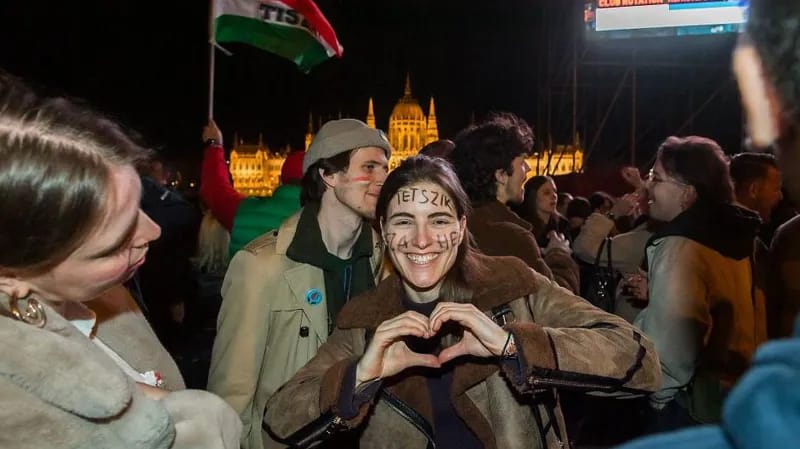
Viktor Orbán’s 16-Year Reign Concludes As Péter Magyar Leads Tisza Party To Historic Victory
Over the past two years, Magyar traversed villages, town squares, and cities, galvanizing citizens frustrated by the pervasive cronyism and corruption that has plagued Hungary. “Never before in the history of democratic Hungary have so many people voted, no single party has ever received such a strong mandate,” he stated on Sunday night, following a record voter turnout of 79.5%.
Orbán’s lengthy rule was built upon four consecutive election victories and overwhelming majorities, but the reality of his defeat became evident within minutes of the results beginning to roll in. As his supporters awaited news in Budapest, Magyar shared an unexpected message on Facebook: “Viktor Orbán just called me on the phone and congratulated us on our victory.” At that moment, only 30% of the votes had been tallied.
Shortly thereafter, Orbán addressed his supporters at a conference center a mile downriver, flanked by his visibly disappointed Fidesz colleagues. “The result of the election is clear and painful,” he expressed, thanking the estimated 2.5 million Hungarians who remained loyal to him. “The days ahead are for us to heal our wounds.”
As news spread among Magyar’s supporters, celebrations erupted at the nearby hotel that served as Tisza’s headquarters. Activists embraced one another in joy.
Magyar has pledged to reverse many of Orbán’s changes regarding education and healthcare, address corruption, restore judicial independence, and dismantle the widely criticized patronage system known as NER, which has enriched party loyalists at the expense of state resources.
To implement constitutional changes, he requires a two-thirds majority of 133 seats in parliament; however, with Tisza projected to achieve 138, he is poised for significant reform.
Many of Magyar’s supporters are not traditional backers; he was once an ally of Orbán but has now led the charge against him. “He’s someone you cannot be absolutely sure of,” remarked Ágnes, a lawyer. “But we’re at a point where we need to hope for something better, which he promises—and we genuinely hope his promises come true.”
Another target for Magyar’s administration will be the pro-Orbán state media. The M1 TV channel has consistently aligned with Fidesz’s narrative, alongside independent websites that were acquired by Orbán’s allies over time.
In a moment of confusion, M1 re-aired a speech delivered by Péter Magyar shortly after the voting concluded. Although he had expressed optimism about winning at that time, the speech quickly became outdated, he had already claimed victory.
For some time, Hungary seemed divided into two parallel realities. In one, Viktor Orbán assured his supporters and viewers that they were on the brink of securing another four years in power, buoyed by opinion polls from friendly sources that continued to predict a Fidesz triumph right up until Sunday evening.
In the contrasting reality was Magyar, who drew large crowds wherever he campaigned, supported by reputable pollsters indicating a growing advantage over his opponent.
Yesterday night, these two realities collided, revealing only one to be true.
As he slowly navigated through the throngs of supporters before taking the stage alongside his party members, Magyar addressed the audience. “You accomplished a miracle today; Hungary has made history,” he declared, eliciting chants of “Ria-Ria-Hungaria!”
He compared their electoral success to the Hungarian revolution of 1848 and the resistance against Soviet occupation in 1956.
Once an outspoken critic of Soviet dominance, Orbán has transformed into a close ally of Putin. His endorsement of inexpensive Russian oil and gas has rendered him increasingly unpopular within the EU, which is striving to reduce its dependence on Russian resources. Additionally, Orbán has backed away from an EU commitment to provide Ukraine with a €90 billion (£79 billion; $105 billion) loan.
”Russians go home,” chanted Magyar’s supporters as the incoming prime minister pledged to foster improved relations with the EU. Meanwhile, Kremlin spokesman Dmitry Peskov stated that Moscow wishes to maintain amicable ties with Budapest. “The Hungarians have made their choice. We respect this decision and anticipate continuing our pragmatic interactions with Hungary’s new leadership,” he remarked. “Perhaps we should exercise patience and see how things unfold.”
Poland’s Prime Minister Donald Tusk was among the first European leaders to congratulate Magyar on his “glorious victory,” adding in Hungarian, “Ruszkik Haza”, Russians go home.
Magyar promised that his inaugural trip abroad as prime minister would be to Warsaw, aiming to reinforce Hungary’s longstanding friendship with Poland spanning a millennium. He also intends to visit Brussels, where he hopes to persuade the European Commission to release up to €17 billion in funds that have been frozen due to issues related to corruption and judicial independence.
Following an extensive campaign that included up to seven speeches daily and energized audiences throughout the country, Magyar carries significant momentum. In contrast, his defeated opponent appeared weary and disillusioned during his final campaign address on Saturday night, as if he sensed the impending outcome.
By: Magdalene Agyeiwaa Sarpong