

Burkina Faso, Mali and Niger are moving closer to launching the Sahel region’s first shared telecommunications satellite through a partnership with Russia, signaling a major step in both technological development and geopolitical realignment for the Alliance of Sahel States (AES).
The discussions took place during a meeting in Ouagadougou between Russia’s ambassador, Igor Martynov, and Burkina Faso’s Prime Minister Jean Emmanuel Ouedraogo, according to Sputnik Africa.
Representatives discussed broader cooperation in space exploration and the use of Russian space technologies for economic and security applications, a signal that the AES could tap into satellite technology to improve governance and infrastructure.
Among those present was the cosmonaut Alexandre Gorbounov, further highlighting the symbolic importance of the space dialogue for the Sahel bloc.
The satellite talks build on earlier agreements between Russia and AES countries to develop space capabilities.
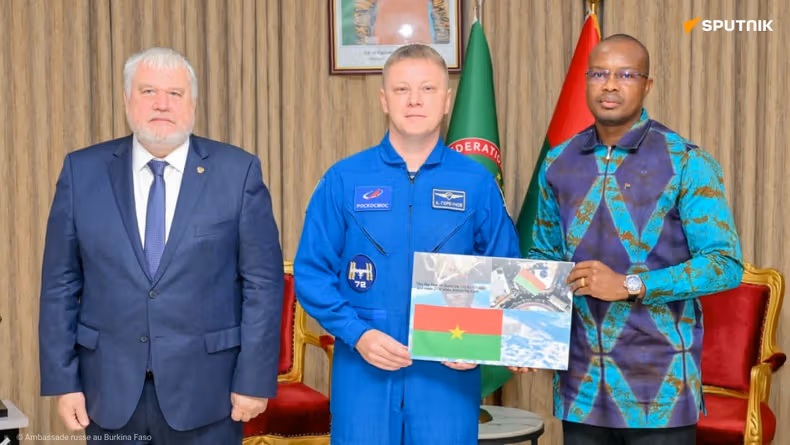 The meeting was held in Ouagadougou with high-level figures including cosmonaut Alexandre Gorbounov
In September 2024, ministers from Mali, Niger and Burkina Faso met with Russia’s aerospace agency Roscosmos to pursue joint satellite projects, including telecommunications and remote sensing satellites intended to expand broadband internet access, secure encrypted communications, and improve surveillance of vast, under-served territories in the Sahel.
The projects are designed to enhance both civilian and national security capacities.
Strategic gains for the AES and Russia’s expanding role
For the Alliance of Sahel States, jointly pursuing satellite technology represents more than a communications upgrade; it is part of a broader push for sovereignty and technological independence.
AES leaders have been explicit about reducing reliance on external actors and building regional capabilities in areas such as security, infrastructure and digital connectivity.
The satellite initiative would provide internet, mobile phone services and broadcasting in remote areas where traditional infrastructure is lacking, while remote sensing technology could support border monitoring and disaster response across the Sahel’s vast terrain.
For Russia, deepening cooperation with the AES advances long-term strategic interests in the region. Moscow was the first country to formally recognise the Alliance of Sahel States, showing shared political positions and a commitment to partnership on security and diplomatic fronts.
Russia’s engagement with the AES also reflects its broader pivot toward Africa as Western influence wanes following the withdrawal of French and other Western forces from the Sahel over recent years.
If realised, an AES communications satellite could mark a symbolic leap in technological cooperation and signal a deepening geo-strategic alignment between Moscow and this emerging West African bloc.
SOURCE: africa.businessinsider.com