
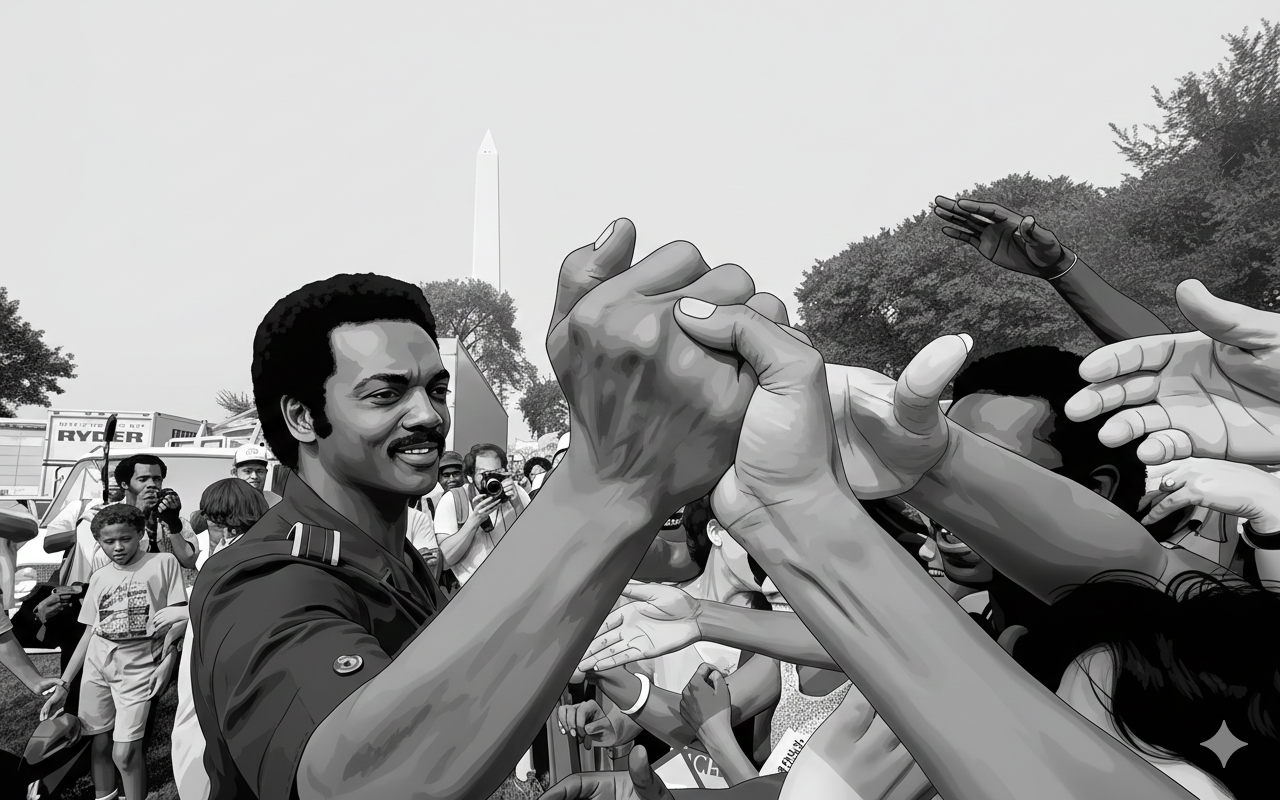
Rev. Jesse Jackson, one of the most visible faces of the American civil rights struggle, has died at 84.
His family confirmed that he passed away Tuesday. They said he died peacefully, surrounded by relatives.
In a statement, the family described him as more than a public figure. “Our father was a servant leader not only to our family, but to the oppressed, the voiceless, and the overlooked around the world,” they said. “We shared him with the world, and in return, the world became part of our extended family. His unwavering belief in justice, equality, and love uplifted millions, and we ask you to honor his memory by continuing the fight for the values he lived by.”
While many remember Jackson for his powerful speeches, those close to his work say his greatest impact may have been his ability to bring different groups together under one cause.
He was born in Greenville, South Carolina, and came of age during the height of the civil rights movement. As a young activist, he worked closely with Rev. Martin Luther King Jr. and took part in major protests, including the 1965 march from Selma to Montgomery, Alabama. After King’s assassination in 1968, Jackson continued organizing, refusing to let the movement slow down.
Over the years, he built organizations focused on economic fairness and political action. In 1971, he founded People United to Save Humanity (PUSH), which later became part of the Rainbow/PUSH Coalition. The group pushed for better jobs, stronger voting rights, and more opportunities for Black communities.
Jackson also made history in politics. He ran for the Democratic presidential nomination twice, in 1984 and 1988. In his first campaign, he won more than 18% of the vote in the primaries. Four years later, he won 11 contests. Though he did not secure the nomination, his campaigns showed that a Black candidate could compete nationally and build a broad coalition.
He faced criticism along the way. During his 1984 campaign, he used a slur about Jewish people in a newspaper interview. After first denying it, he later admitted it and publicly apologized.
Jackson’s influence was not limited to elections. He often stepped into tense global situations to help free detained Americans. In 1999, he helped secure the release of three U.S. soldiers held in Yugoslavia. A year later, President Bill Clinton awarded him the Presidential Medal of Freedom. Over the decades, he also helped win the release of Americans held in Syria, Cuba, Iraq, and Gambia.
In recent years, Jackson dealt with serious health problems. He revealed in 2017 that he had Parkinson’s disease. He had also been living for more than a decade with progressive supranuclear palsy (PSP), a rare brain disorder that affects movement, balance, and swallowing. He had been hospitalized in November before his death.
Civil rights leader Rev. Al Sharpton said the country had lost a major voice. “our nation lost one of its greatest moral voices,” Sharpton said. He added, “Reverend Jackson stood wherever dignity was under attack, from apartheid abroad to injustice at home. His voice echoed in boardrooms and in jail cells. His presence shifted rooms. His faith never wavered.”
Jackson is survived by his wife, Jacqueline Brown, whom he married in 1962, and their five children, including former Congressman Jesse Jackson Jr.
Public memorial events are expected to take place in Chicago. The Rainbow/PUSH Coalition said more details about celebrations of his life will be shared soon.