

The Artemis II space mission was successfully launched from Florida yesterday, sending four astronauts on a groundbreaking expedition beyond low-Earth orbit for the first time in over half a century. The mission marks a significant milestone in NASA’s efforts to return humans to the moon and eventually send astronauts to Mars.
Following the launch, the crew will spend the initial one to two days in high Earth orbit, conducting thorough systems checks. These checks include testing the Orion spacecraft’s life-support, propulsion, navigation, and communications systems to ensure readiness for deep space travel.
Once these assessments are complete, Orion will execute a crucial engine burn known as translunar injection. This maneuver will propel the spacecraft out of Earth’s orbit and set it on a course toward the moon.
The journey is expected to span several days, during which the astronauts will continue to monitor the spacecraft’s systems as they venture farther from Earth. Orion will then enter a free-return trajectory behind the moon, a path that utilizes the gravitational pull of both the moon and Earth to bring the spacecraft back with minimal fuel consumption. This phase will see Orion reach its farthest point from our planet.
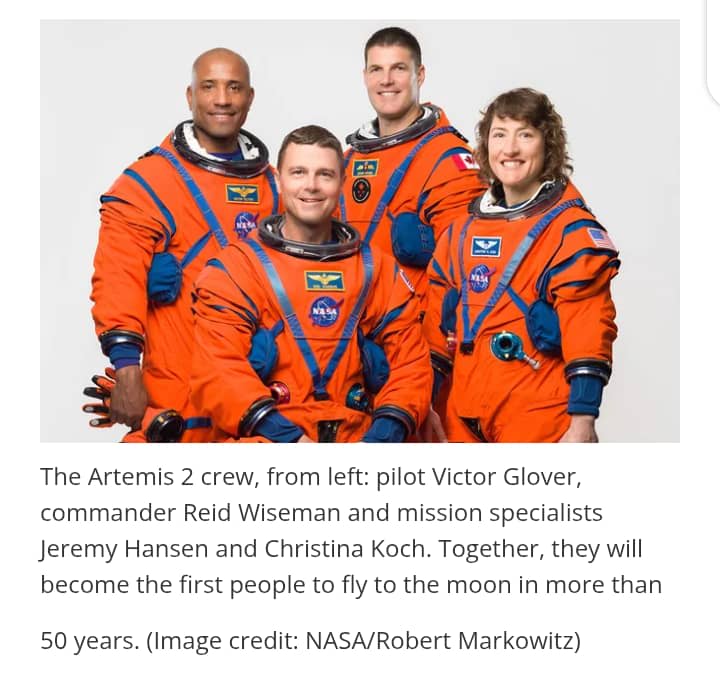
After the lunar flyby, the crew will spend additional days returning to Earth while conducting further tests on power systems, thermal controls, and crew operations in deep space.
As Orion approaches Earth, it will re-enter the atmosphere at speeds of approximately 40,233 km/h (25,000 mph) before splashing down in the Pacific Ocean. Recovery teams will be on standby to retrieve the astronauts once they land.
With many people around the globe not yet born when NASA’s Apollo astronauts last set foot on the moon, Artemis is being heralded as a mission for a new generation.
”There are many individuals who do not remember Apollo. Generations have come and gone since that era,” stated NASA science mission chief Nicky Fox earlier this week. “This is their Apollo.”
By: Magdalene Agyeiwaa Sarpong