

Tensions are rising fast amid violent confrontations between protesters and federal agents enacting President Donald Trump’s deportation purge more than a week after the killing of Renee Good by an ICE agent.
This might be a local showdown. But it’s becoming a national political and cultural moment as cellphones constantly flash with emotionally charged imagery. In one barely believable scene, a disabled woman was pulled out of her car by ICE agents as she drove to a traumatic brain injury appointment.
Other videos show demonstrators chanting expletives at federal officers in the streets. In a polarized nation, everyone can choose an incident to suit their political preference.
This is ruthless crackdown theater choreographed by the president. Minneapolis has become a petri dish for his hardline immigration policies, zeal for militarized law enforcement tactics and attempts to use immigration as a cudgel to crush progressive values in cities that reject his strongman leadership.
Yet the president may also be pushing the country to a pivot point that could end up hurting him politically. While his vow to bolster the US southern border was popular, there’s mounting evidence from opinion polls that Americans are alienated by the bellicose ICE sweeps in a year when Republicans are already dreading the midterm elections.
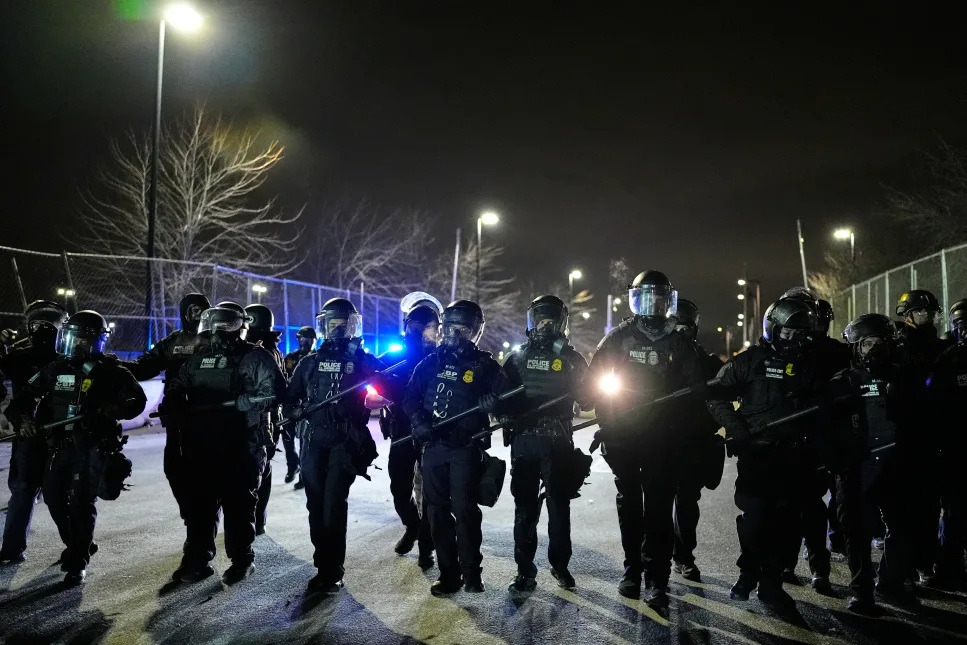 Federal immigration officers confront protesters outside Bishop Henry Whipple Federal Building in Minneapolis on January 15, 2026. Yuki Iwamura/AP
Trump risks undermining one of his perpetual political strong points — immigration policy — by creating a distinction in the public mind between border security and callous enforcement hundreds of miles away. In Trump’s first term, pictures of undocumented migrant children in cage-like detention were too much for many citizens. In his second, public tolerance for deportations may run deeper. But he’s testing it to its limits in Minnesota.
Federal officials say their surge of 3,000 federal agents into Minnesota is a prudent bid to address out-of-control immigration under the Biden administration and a way to make America safer. They accuse local Democratic leaders of shielding criminals and inciting violence that endangers Immigration and Customs Enforcement officers.
Yet the sight of masked, armed men in camouflage piling out of cars, tackling people on the streets and demanding citizenship papers evokes authoritarian imagery that feels distinctly un-American.
These are not traditional policing tactics designed to avoid escalation. It’s as if the administration intends the opposite.
How the White House justifies its crackdown
If officials wanted to cool temperatures, they could. ICE tactics could be moderated. Enforcement could be more subtle and targeted. National authorities could invite their state counterparts to participate in the investigation into the shooting of Good, a 37-year-old mother, instead of prejudging the outcome. All of this could take place without compromising the principle that immigration law must be implemented and without breaking faith with millions of voters who felt less safe because of President Joe Biden’s lax border policies.
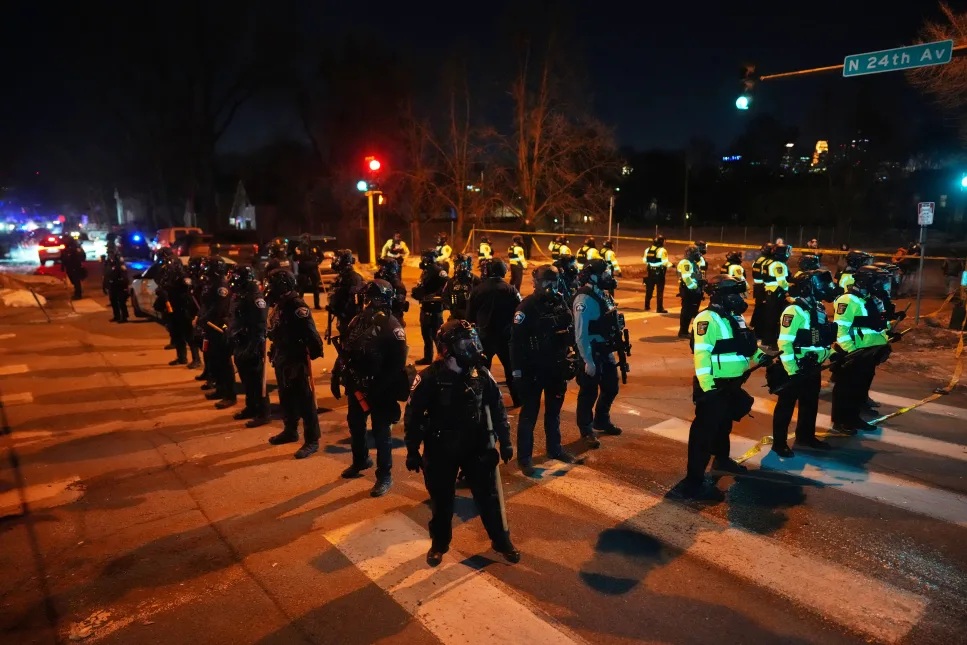 Law enforcement officers stand after a shooting in Minneapolis on January 14, 2026. Adam Gray/AP
But Trump has chosen not to do this. It’s therefore fair to ask whether he’s pleased with the political tumult and violence that erupted as soon as ICE officers descended on Minneapolis.
On Thursday, Trump threatened to invoke the Insurrection Act if the “corrupt politicians of Minnesota don’t obey the law and stop the professional agitators and insurrectionists from attacking the patriots” of ICE. The move would allow him to deploy Minnesota’s National Guard and to send regular troops into the state.
The law hasn’t been invoked since the Los Angeles riots in 1992 and is typically done in cooperation with state leaders. In this case it would override their wishes, representing a stunning challenge by federal authorities to the power of states that would ignite a constitutional storm.
White House press secretary Karoline Leavitt on Thursday implicitly rejected concerns about the aggressive tactics of ICE, and the increasing legal and constitutional concerns about the crackdown in Minneapolis. She said Trump’s warning about the Insurrection Act spoke “very loud and clear” to Democrats who she claimed were encouraging “violence against federal law enforcement officers.” And she complained that such leaders were blocking their local law enforcement from cooperating with ICE because they were “deranged in their hatred” for Trump.
Homeland Security Secretary Kristi Noem, meanwhile, told reporters at the White House that she had discussed with Trump his authority to utilize the Insurrection Act. This is hardly the rhetoric of an administration seeking to tone down the tension.
Trump’s motivations — aside from his perpetual desire to look strong — are not yet fully clear. He clearly enjoys invoking the specter of unlimited presidential power. He may be trying to intimidate local officials. Perhaps he wants to take the heat off ICE agents by demonizing demonstrators. Or, as he often does, Trump may be seeking to create a narrative for conservative media.
But this is also a moment to which Trump has been building for years. Ever since his first presidential campaign, he’s been spinning a tale of American — especially Democratic — cities as dystopian hellholes that need a strongman’s hand. He’s portrayed Minneapolis in such a light, demeaning its Somali American community as criminal “garbage” that should be thrown out of the country.
This grim vision is a way of justifying his own thirst for powers for which most presidents don’t reach. And perhaps it’s also part of his endless quest for personal dominance.
Nighttime in Minneapolis has become tense and dangerous.
The atmosphere was even more unsettled Thursday evening, a day after the Department of Homeland Security said a federal agent shot and injured a man after he allegedly assaulted the agent. The DHS said two people came out of a nearby apartment and attacked the officer with a snow shovel and a broom handle. After the suspect got loose and joined the attack, the officer fired “defensive shots,” DHS said, striking the man in the leg. CNN has not independently confirmed the government’s depiction of the incident.
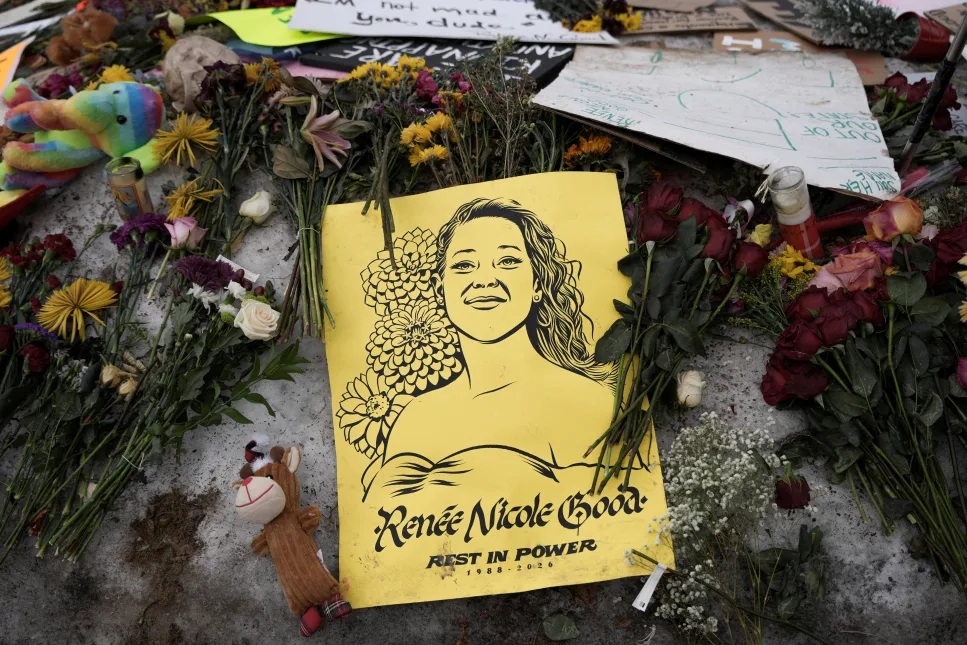 A painting depicting Renee Nicole Good lies on the ground at a makeshift memorial on January 15, 2026. Tim Evans/Reuters
Some statements by Democrats have also seemed to stoke political agitation among demonstrators, especially in the emotional aftermath of Good’s killing.
But amid the worsening public safety situation, Minnesota Gov. Tim Walz, a Democrat, on Thursday issued a direct appeal to Trump on X. “Let’s turn the temperature down,” he wrote. Walz also called on Minnesotans to speak out loudly but peacefully. “We cannot fan the flames of chaos. That’s what he wants,” Walz wrote.
Minneapolis Mayor Jacob Frey, another Democrat, warned Wednesday that everyday life in his city was being severely constrained, with people afraid to go out as they see neighbors being taken away. “That’s not America. So, I’m calling for peace. Everybody has a role in achieving that peace,” he said.
ICE’s aggressive behavior is raising civil liberties, human rights and constitutional alarms. The ACLU of Minnesota has filed a lawsuit against the federal government over ordeals suffered by several American citizens in the last two months. In one incident, Mubashir Khalif Hussen, 20, was walking during his lunch break when he was violently stopped, pinned to the ground, placed in a headlock and taken away by agents who refused to examine his US passport card until after he was in detention.
Minneapolis City Council President Elliott Payne told CNN that “many of our residents are out there legally observing the operations of our federal government to ensure that our constitutional rights are not getting violated.” He added: “What I’m seeing firsthand is our constitutional rights being violated.”
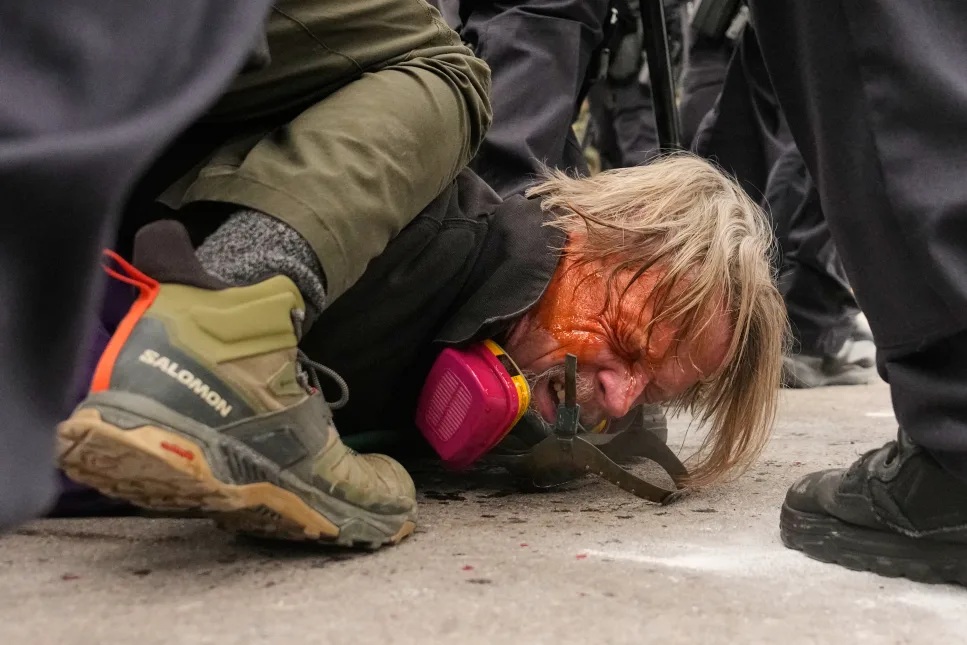 A man is pushed to the ground as federal immigration officers confront protesters outside Bishop Henry Whipple Federal Building in Minnesota, on January 15, 2026. John Locher/AP
The Trump administration’s position is that it’s up to Minnesotans to cool tensions by getting out of the way — even though many citizens believe ICE is flouting the Constitution and breaking the law. But the evidence suggests Trump doesn’t really want to see tempers ebb.
“This is something that I saw long ago, and it is part of a clear pattern that he was setting up,” Democratic Rep. Dan Goldman of New York told CNN’s Kasie Hunt on Thursday. “You send in violent ICE agents to inflame tension, to incite violence themselves. … (Trump) will say, ‘there’s so much unrest and chaos. We need the Insurrection Act’ so that he can usurp more power and send the military in.”
If Trump does this, he’s playing with political fire.
A new CNN poll conducted by SSRS finds that most Americans view the fatal shooting of Renee Good as an inappropriate use of force. Less than one-third think ICE operations have made cities safer.
This poses an intriguing political question.
Growing public dissatisfaction and the potential electoral implications mean it might make sense now for Trump to blink — if only to slow the torrent of videos that reflect poorly on ICE tactics and could turn more voters against his party.
But there’s another possibility. The pace of escalation in Minnesota, which officials are making no attempt to stop, could indicate an administration that’s become less constrained by potential political consequences.
Trump’s belligerence at home and abroad may show that this president and his highly committed aides are now most concerned with using every moment they have to enforce irrevocable change on the character of the country.
SOURCE: edition.cnn.com