
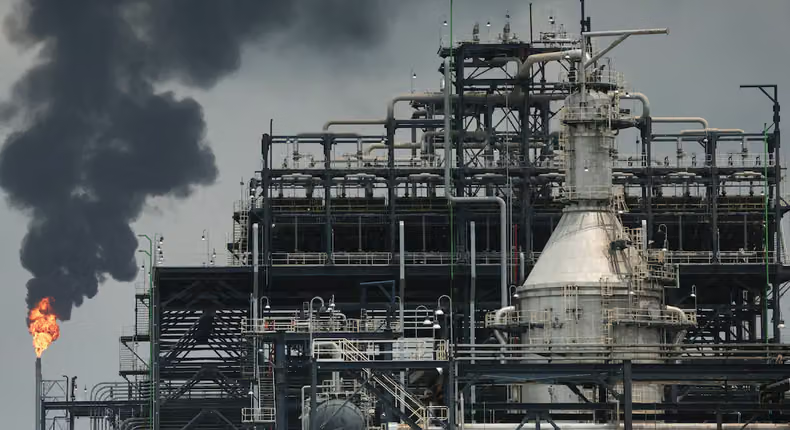
Nigeria’s Dangote refinery supplied about 80,000 barrels of jet fuel per day to Europe during the second quarter of 2026
Europe previously obtained a large share of its imported jet fuel from refineries in the Middle East. However, the conflict and disruption to regional shipping have removed about half of those imports, forcing European traders to draw supplies from farther afield.
The shift has created an opening for two major refining centres on opposite sides of the world: Nigeria’s Dangote Petroleum Refinery and South Korea’s export-focused refining industry.
According to a Reuters report, Europe has increased imports from Nigeria, the United States and Canada, while South Korea has become its latest major supplier.
Energy Aspects expects Europe to face a jet fuel deficit of 510,000 barrels per day in the fourth quarter of 2026.
That gap contrasts with a projected surplus of 419,000 barrels per day in the Asia-Pacific region and 18,000 barrels per day in the United States.
The imbalance explains why fuel is travelling much longer distances to reach European airports. Surplus production in Asia can command higher prices in Europe, making the additional shipping cost worthwhile for refiners and commodity traders.
Europe’s independently held jet fuel stocks in the Amsterdam-Rotterdam-Antwerp hub fell to their lowest level in seven years during the week ending September 10.
The hub is central to Europe’s fuel trade and serves airports and distributors across the continent. Low inventories there leave the aviation market with a smaller cushion if the war causes further supply interruptions.
PP
“With the continent expected to remain short of jet fuel, Europe’s imports are set to continue,” James Noel-Beswick, head of commodities at Sparta Commodities, said.
Nigeria’s growing role rests largely on the 700,000-barrel-per-day Dangote refinery, which has moved from replacing imported Nigerian petrol to influencing international fuel markets.
Kpler shipping data show that Europe imported about 80,000 barrels per day of jet fuel from the refinery during the second quarter.
That volume covered roughly 13% of the supply shortfall at the time and made Dangote the largest individual supplier of jet fuel to Europe. On a country basis, only the United States supplied Europe with more aviation fuel than Nigeria.
This marks a major change in Nigeria’s place in the global petroleum trade. For years, the country exported crude oil while buying large quantities of petrol, diesel and aviation fuel from foreign refineries.
Dangote’s entry has begun to reverse part of that trade. The refinery is now competing with established plants in the United States, Asia and the Middle East for customers in Europe and Africa.
Its financial performance reflects the strength of the export market. The refinery recorded revenue exceeding $13 billion and net profit of $1.82 billion in the first half of 2026, after posting a $476 million loss in 2025.
The refinery disclosed the figures during its public share offer, which seeks to raise about $1.6 billion. The offer gives investors access to a business valued at approximately $49 billion, according to an Associated Press report.
The current shortage therefore matters beyond fuel exports. Strong demand and refining margins could influence how investors value the refinery as its shares move towards trading on the Nigerian Exchange.
South Korea has entered the European market from a different position. It already has one of Asia’s largest and most sophisticated refining industries but must export a significant portion of its production because domestic demand cannot absorb it all.
Its jet fuel exports to Europe reached approximately 129,000 barrels per day in September, the highest level since October 2022, according to Kpler and LSEG shipping data.
South Korean refineries produced almost 13.89 million barrels of jet fuel in July, their highest monthly output in seven years. Total refinery runs rose by 16% from June to 2.7 million barrels per day.
The combination of higher output in South Korea and depleted stocks in Europe has redrawn aviation fuel routes. Cargoes that might normally remain in Asia are now travelling thousands of kilometres to European storage terminals.
The fuel disruption is no longer only a problem for commodity traders.
The pressure on Europe’s fuel market comes as airlines are already adjusting their operations to higher energy costs. Wizz Air has reduced its planned winter capacity by 5%, citing the financial pressures created by the Iran war.
The airline carried 69.7 million passengers in its last financial year and operates 269 aircraft.
Although Wizz Air has hedged about 80% of its fuel requirements, smaller airlines or those with weaker hedging positions may face greater pressure if European prices remain high.
Expensive fuel can affect airlines in three ways, higher fares, the suspension of routes that are already only marginally profitable, or slower growth in the number of available flights.
There is no evidence yet that Europe’s overall shortage will lead to widespread flight cancellations. However, low stocks and a 510,000-barrel daily deficit leave airlines and airports more exposed if Middle Eastern supplies deteriorate further.
For Nigeria, the crisis shows how additional domestic refining capacity can change the country’s influence abroad. Rather than exporting only crude oil, it is now supplying a higher-value product required to keep aircraft operating in one of the world’s largest aviation markets.
“Dangote’s role is likely to increase materially in coming years,” Janiv Shah of Rystad Energy said.
SOURCE: africa.businessinsider.com