

A Syrian court has handed down a death sentence against former President Bashar al-Assad in absentia after finding him responsible for war crimes and crimes against humanity committed during the country’s devastating civil war.
The ruling marks the first criminal conviction against Assad, who escaped to Russia with members of his family after his government collapsed in December 2024, bringing an end to more than five decades of Assad family rule.
Atef Najib, Assad’s cousin and former security chief in the southern province of Deraa, was also condemned to death.
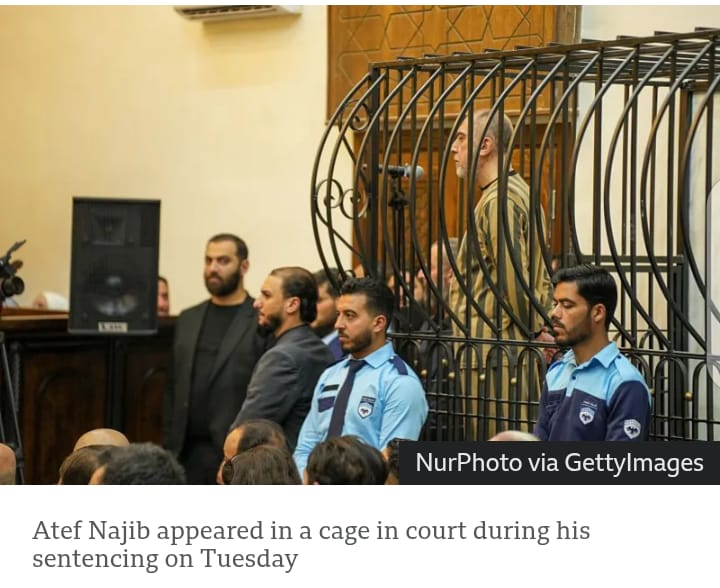
Unlike Assad, Najib was present in court and appeared in prison clothing as the judgment was delivered.
Deraa is regarded as the starting point of the popular revolt against Assad’s government.
The unrest began in March 2011 after several children were detained and allegedly abused for writing anti-government messages on a wall.
Security forces responded with a forceful crackdown, triggering demonstrations across Syria that eventually developed into a prolonged armed conflict.
The war claimed hundreds of thousands of lives and displaced millions of people.
Syria’s transitional authorities began prosecuting individuals linked to the former government earlier this year as part of efforts to hold members of the previous administration accountable.
Najib, regarded as one of the most senior former officials to face proceedings, was found guilty of several offences, including murder, the deliberate killing of children below the age of 15 and torture resulting in death.
Six other former military and intelligence figures were also sentenced to death in absentia.
Among them was Maher al-Assad, Bashar’s younger brother and former commander of the powerful Fourth Division of the Syrian army.
He, like Bashar, reportedly fled to Moscow following the collapse of the government.
Former Defence Minister Fahd al-Freij was among the other defendants convicted by the court.
For survivors and relatives of those killed during the uprising, the judgment represents a long-awaited moment of accountability.
Nouha al-Masri, a member of the five-person prosecution team and a plaintiff in the case, lost her brother during the March 2011 violence at Al-Omari Square in Deraa.
She said the judgment acknowledged the suffering endured by victims, families of those killed, people who disappeared and detainees who were subjected to abuse.
Masri said she had waited 15 years for justice and described the ruling as only the beginning of a broader effort to address crimes committed under the former government.
She also called for further prosecutions, saying that the new Syria must ensure that those responsible for serious abuses cannot escape accountability.
However, questions remain over whether the transitional authorities can bring Bashar and Maher al-Assad back from Russia to face the sentences handed down against them.
The new Syrian leadership previously issued an arrest warrant for Bashar al-Assad in December on allegations involving murder and torture.
Assad fled the country after forces commanded by Ahmed al-Sharaa, who is now Syria’s president, captured Damascus following an 11-day offensive that ended the Assad dynasty.
Since taking control, the transitional administration has arrested numerous former government officials and members of the security services.
Many senior figures, however, remain beyond its reach, particularly those who have taken refuge in Russia.
Before the latest ruling, attempts by Syrian opposition activists to bring legal cases against Assad in Western jurisdictions had failed to produce a conviction.
Assad became president in 2000 following the death of his father, Hafez al-Assad, who had ruled Syria for decades.
Bashar was not initially expected to inherit the presidency, but became his family’s successor after his elder brother, Basil, died in a road accident in 1994.
A member of Syria’s Alawite minority, Assad maintained strong representation of the community within the country’s armed forces, intelligence services and security institutions.
His presidency was ultimately dominated by the conflict that erupted in 2011 and lasted until the collapse of his government in 2024.
By: Magdalene Agyeiwaa Sarpong