

More than 150 migrants were brought to safety on Tuesday after a small vessel attempting to cross the English Channel from France to the United Kingdom caught fire, prompting a large-scale rescue involving both French and British emergency teams.
French maritime authorities reported that the overcrowded boat departed the northern French coast on Monday night before developing mechanical problems during the journey.
According to officials, the vessel’s engine ignited, causing the craft to deteriorate rapidly and forcing emergency services to launch a coordinated rescue mission.
A total of 157 people were safely evacuated and transported to the French port of Boulogne-sur-Mer.
Authorities said there were no confirmed deaths or injuries following the incident.
Officials explained that during the early stages of the crossing, five passengers accepted assistance after requiring urgent help.
However, many of those on board initially declined rescue efforts despite repeated offers from French patrol crews, insisting on continuing toward British waters.
The French maritime prefecture stated that rescue personnel avoided boarding the vessel at that point because of concerns that its unstable structure could collapse if additional weight was placed on it.
Intervention became unavoidable after the fire broke out and the boat’s condition worsened significantly.
The operation involved rescue assets from both countries.
French vessels recovered 103 migrants, while British Border Force ships and the RNLI Eastbourne lifeboat rescued the remaining 54 before all survivors were returned to France for medical assessment and further assistance.
The UK government confirmed that the Border Security Command was alerted after receiving reports of a migrant boat in distress within the French search-and-rescue zone.
British crews assisted French authorities throughout the emergency response.
A government spokesperson said the incident highlighted the extreme risks associated with irregular Channel crossings, adding that Britain would continue working closely with France and other international partners to disrupt people-smuggling operations and discourage dangerous sea journeys.
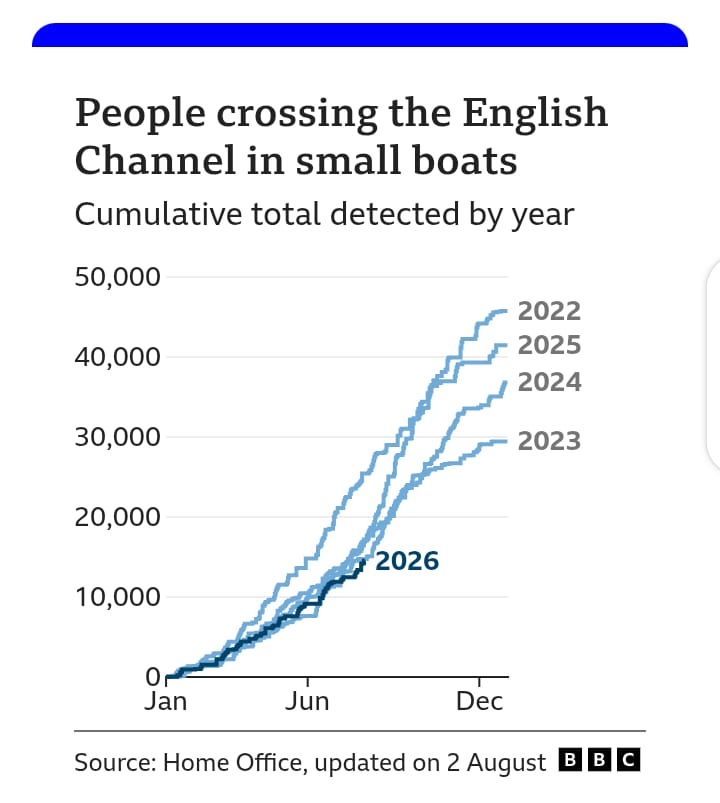
The rescue occurred a day after Prime Minister Andy Burnham reaffirmed his administration’s commitment to reducing the number of migrants reaching Britain in small boats.
Speaking during a visit to Dover, he said stronger action had been taken against organised smuggling networks, including increasing the number of enforcement officers operating on both sides of the Channel.
He also stressed the need for expanded legal migration pathways.
The incident has renewed political debate over migration policy.
Shadow Home Secretary Chris Philp criticised French authorities, arguing that stronger intervention was needed before boats leave the shoreline.
Reform UK leader Nigel Farage also repeated his party’s proposal to use the Royal Navy to prevent Channel crossings if elected to government.
Migration has remained a key political issue following the recent surge of migrants entering Spain’s North African enclave of Ceuta.
Opposition parties continue to press the government over its handling of border security and asylum processing, while the Liberal Democrats have called for closer cooperation with European partners and faster decisions on asylum applications.
Britain and France earlier this year signed a three-year agreement worth £662 million aimed at reducing illegal Channel crossings.
The package includes additional riot-trained police on French beaches, expanded surveillance using drones and helicopters, and provisions allowing the UK to reconsider part of its financial contribution if expected results are not achieved.
By: Magdalene Agyeiwaa Sarpong