

Ukrainian President Volodymyr Zelensky has removed Commander-in-Chief Oleksandr Syrskyi from his post, appointing veteran battlefield commander Mykhailo Drapatyi as the country’s new military chief in the latest overhaul of Ukraine’s defence leadership.
The leadership change follows the recent dismissal of Defence Minister Mykhailo Fedorov, a decision that sparked several days of nationwide demonstrations and intensified political pressure on the government.
Reports suggesting tensions between Fedorov and Syrskyi were later reinforced by subsequent developments.
Fedorov, 35, earned widespread recognition for modernising the Defence Ministry, promoting transparency, strengthening anti-corruption efforts and introducing technology-driven reforms within Ukraine’s armed forces.
Syrskyi, 60, meanwhile, was often viewed as representing a more traditional military command style that critics believed slowed institutional change.
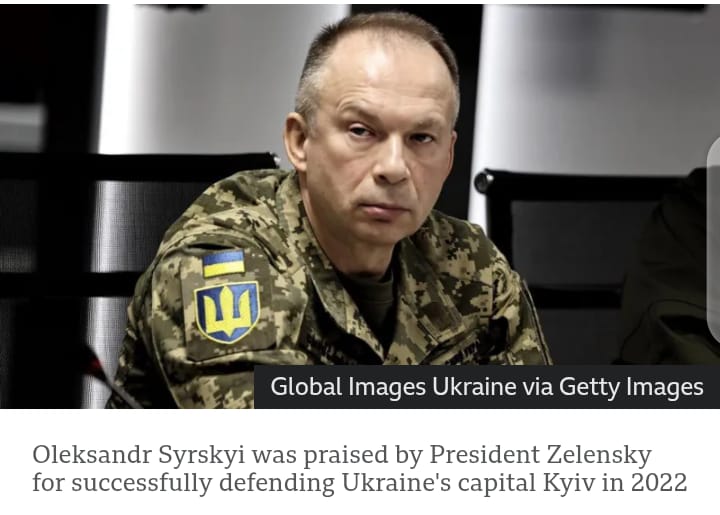
In a farewell statement shared on Telegram, Syrskyi defended his tenure, saying the armed forces had progressed from a defensive posture to sustained offensive operations.
He expressed confidence that the momentum achieved under his leadership would continue after his departure.
His successor, 43-year-old General Mykhailo Drapatyi, pledged to lead with commitment and responsibility while paying tribute to the soldiers defending Ukraine.
He also acknowledged Syrskyi’s contribution to building the country’s military, describing his predecessor as an important figure in its development.
President Zelensky thanked Syrskyi for his service, particularly his role in organising Kyiv’s successful defence during the opening phase of Russia’s full-scale invasion in 2022.
The president also disclosed that he had met with former Defence Minister Fedorov and proposed another senior government position, although no confirmation has been given on whether the offer has been accepted.
Fedorov was replaced by former Security Service of Ukraine (SBU) official Yevhenii Khmara, who is currently serving as acting defence minister.
President Zelensky indicated that the formal procedures surrounding the appointments would be completed shortly.
Following Drapatyi’s appointment, Fedorov welcomed the decision, describing the new military chief as a symbol of renewal in Ukraine’s struggle against Russian forces.
He argued that the appointment reflected the public’s demand for reform and praised Drapatyi as someone capable of leading the armed forces into a new phase.
Fedorov also revealed that he had personally spoken with Syrskyi to thank him for overseeing the defence of the Kyiv region and several key military operations.
At the same time, he stressed that Ukraine must move beyond past shortcomings and accelerate reforms to strengthen its war effort.
Although Fedorov served as defence minister for only a short period after taking office in January, he gained recognition for introducing data analysis to evaluate battlefield performance, expanding drone warfare initiatives and developing digital systems that rewarded military units for successful combat operations.
Before joining the Defence Ministry, he served as Ukraine’s minister of digital transformation, where he launched the volunteer “IT Army of Ukraine” to support cyber operations against Russia.
Public frustration over Fedorov’s dismissal fuelled nearly a week of protests, with demonstrators demanding broader leadership changes within the defence establishment.
The replacement of Syrskyi with Drapatyi is widely viewed as an attempt by Zelensky to ease public discontent and restore confidence in the military’s leadership.
Drapatyi is regarded as a highly respected frontline commander and is believed to have maintained a close professional relationship with Fedorov.
His appointment has been welcomed by many observers as an opportunity to inject fresh thinking into Ukraine’s military command.
For now, Khmara will continue overseeing the Defence Ministry while working alongside Drapatyi to prepare a revised defence strategy focusing on military restructuring, weapons procurement, logistics and expanded drone capabilities.
Earlier this week, Syrskyi addressed speculation surrounding his relationship with Fedorov in an opinion article, insisting their interactions remained professional despite public debate.
He acknowledged that difficult decisions involving recruitment, procurement and military planning often required careful judgement rather than political rhetoric, arguing that practical action, not public controversy, would ultimately determine success on the battlefield.
Despite the latest appointments, many protesters continue to call for Fedorov to be restored to a position where he can directly influence defence reforms and military innovation.
Whether President Zelensky’s latest reshuffle will fully restore public confidence remains uncertain.
By: Magdalene Agyeiwaa Sarpong